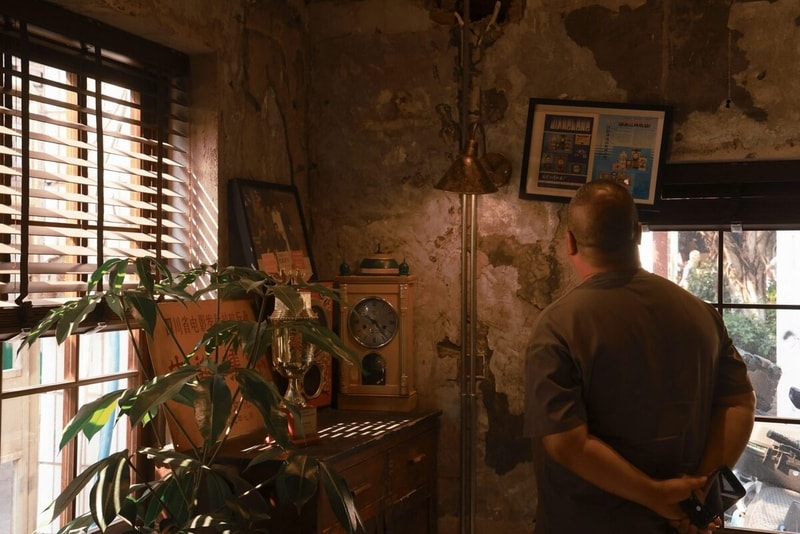
The Jiangling Teahouse is an adaptive reuse project by Studio We Live in Chongqing, China. Jiangling Teahouse occupies a former workers’ cinema built in 1957 for the Jiangling Machinery Factory. The building was abandoned and later used as a parking lot before being converted into a teahouse and food market.
The renovation preserves original roof trusses, brick walls, cinema seating, and historic architectural elements. New stairs, platforms, and mezzanine connections were introduced to create multiple levels for dining, gathering, and circulation throughout the building. The entrance features a canopy constructed from recycled timber sourced from the site. Inside, original artifacts including film reels, cabinets, documents, and projector components are displayed as part of a dedicated exhibition area.
The main hall retains a large screen framed by red curtains, while food vendors occupy the perimeter. A portion of the original cinema seating remains in place, and faded wall slogans have been preserved alongside the existing structure. New steel staircases and platforms connect the ground floor to upper-level seating areas modeled after theater box seats.
Image Credit: Arch-Exist
What's Driving This Trend
- Adaptive Reuse of Cultural Spaces
- Conversions of obsolete civic buildings into multifunctional hospitality and retail hubs create opportunities to reframe heritage assets as revenue-generating community anchors.
- Industrial Heritage as Brand Authenticity
- Preserving original machinery, signage, and structural elements offers a compelling narrative that can differentiate food and beverage concepts through tangible provenance.
- Mixed-use Culinary Halls in Historic Venues
- Combining food vendors, exhibition space, and communal seating within preserved auditoriums enables new social economies around dining and cultural programming.
Who This Affects Most
- Hospitality and Food Service
- Repurposed landmark venues present a platform for premium dining experiences that blend storytelling with locally sourced vendor ecosystems.
- Architecture and Preservation
- Adaptive interventions that retain original fabric while introducing modular circulation and seating strategies can redefine conservation-led commercial projects.
- Retail and Experiential Marketing
- Historic-site activations that integrate exhibitions and branded vendor spaces facilitate immersive retail encounters anchored in place-based authenticity.