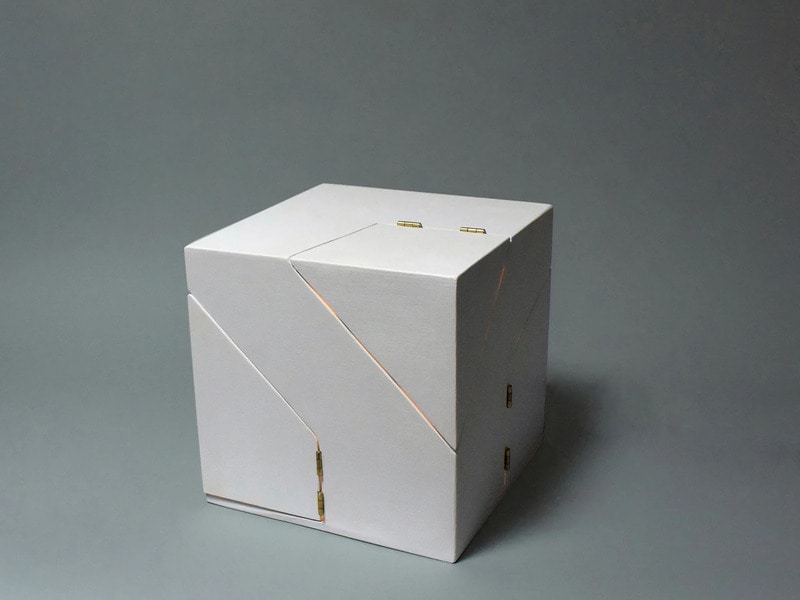
The Interactive Folding Lamp by Michael Jantzen is a lighting object designed as a wooden cube whose form and light output shift through physical interaction. The lamp is constructed from hinged wooden panels joined along the cube’s edges, allowing each corner to be folded inward or outward. Adjusting these corners changes the geometry of the cube and alters how light escapes from the interior.
A light source is positioned within the central cavity of the cube, casting illumination onto the interior surfaces. As the panels are folded, openings appear along the edges, redirecting light and creating varied patterns of brightness and shadow. The interaction allows users to control both the shape of the lamp and the character of the light without electronic controls.
The wooden panels are precisely cut and finished to preserve visible grain and material texture. Hinges are integrated discreetly to maintain clean lines when the cube is closed. The lamp can be returned to a complete cube or left partially folded
Image Credit: Michael Jantzen
Why This Trend Is Growing
- Tactile Transformable Objects
- Physical manipulation of hinged panels creates objects whose form and function shift without electronics, enabling new categories of interactive household goods.
- Passive Mechanical Personalization
- Designs that rely on geometry and simple mechanisms offer bespoke user experiences through touch and arrangement rather than software-driven settings.
- Material-first Smart Design
- Visible wood grain and integral joinery combine craftsmanship with responsive behavior, foregrounding sustainable materials in experiential product design.
Industries Being Reshaped
- Home Lighting
- Lamp designs that change illumination through folding introduce a product niche blending artisanal materials with customizable lightscapes for residential environments.
- Furniture Manufacturing
- Hinged-panel construction suggests modular, reconfigurable furniture lines that alter spatial form and function through simple mechanical transformations.
- Hospitality Design
- Interactive wooden fixtures provide opportunities for tactile ambiance modulation in public spaces, shifting mood and spatial perception without digital interfaces.