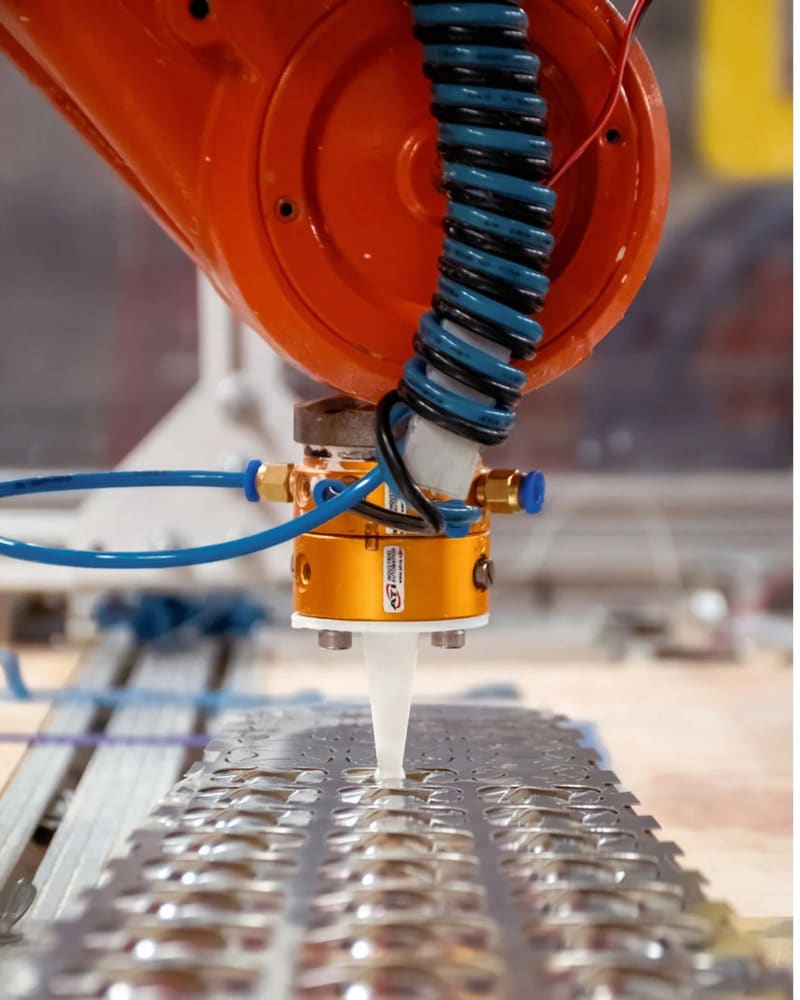
The Hikarigami luminaire was created by Harvard Graduate School of Design students Luke Fiorante, Joseph Fujinami, Annie Xing and Chi Zhang. Inspired by the Japanese art of kirigami, the lighting concept transforms sheet aluminum into a three-dimensional lattice using robotic fabrication instead of conventional molds. A custom computational workflow controls the forming depth of thousands of individual cells, allowing each aperture to respond to the material's geometry while producing a distinctive perforated structure that filters light throughout the object.
The luminaire is assembled from six interlocking aluminum panels without adhesives or mechanical fasteners, creating a single-material construction designed for recyclability and long-term durability. When illuminated, the perforated surface casts layered shadows and highlights that extend beyond the fixture into the surrounding space. Hikarigami received recognition in the sustainability category and earned additional honors in furniture and lighting.
Image Credit: Luke Fiorante, Joseph Fujinami, Annie Xing, Chi Zhang
What Makes This Trend Stand Out
- Robotic Metalforming
- Precision-controlled fabrication is expanding the design vocabulary for sheet metals by enabling complex three-dimensional surfaces without costly molds.
- Mono-material Interiors
- Single-material construction supports easier recycling, longer product life cycles and more transparent sustainability claims in furniture and lighting design.
- Computational Light Sculpting
- Algorithmically varied apertures are turning fixtures into spatial experiences, blending functional illumination with dynamic shadow patterns and architectural ambience.
Sectors Adopting This
- Lighting
- Advanced fabrication methods are creating highly differentiated luminaires that combine sculptural aesthetics, material efficiency and premium design value.
- Architecture
- Robotic forming and perforated metal systems are influencing interior installations, façade elements and spatial features with customizable light-filtering effects.
- Sustainable Design
- Recyclable assemblies without adhesives or fasteners are strengthening circular product strategies across decor, furnishings and built-environment applications.