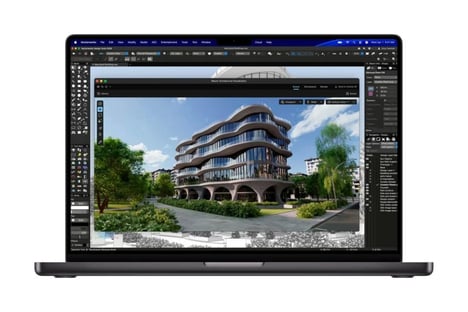

Apple's MacBook Pro now doubles as its first Mac with touch controls, giving laptop buyers a direct way to work on the screen instead of relying only on a keyboard and trackpad. The range starts at $1,999. It reaches $14,549 at the top end, turning one notebook family into a much wider pricing span.
A 16TB solid-state drive at the high end turns the notebook into a mobile home for very large files, reducing the need to juggle external storage. Nano-texture glass on the PROLED XDR display also cuts reflections, which matters more when people are reaching out to use the screen itself.
At $1,999 on the low end and $14,549 at the top, Apple widens MacBook Pro into a longer upgrade path inside one product family. The touchscreen shift and 16TB ceiling push the line closer to workstation territory while keeping it in laptop form.
Image Credit: 9to5Mac, Apple
Key Themes Behind This Trend
- Touch-first Workstations
- Premium laptops are evolving into direct-manipulation workstations, creating space for professional software interfaces built around hybrid touch, keyboard, and trackpad workflows.
- Ultra-capacity Mobility
- Massive onboard storage in portable devices reduces dependence on external drives and cloud transfers, opening new value in mobile production, field editing, and secure local workflows.
- Tiered Premium Computing
- Expansive price ladders within one product family signal demand for highly configurable machines that serve both entry-level professionals and elite power users.
Where This Applies
- Consumer Electronics
- High-end notebook makers can differentiate through tactile displays, glare-reducing materials, and workstation-grade configurations in familiar portable formats.
- Creative Software
- Design, video, audio, and 3D applications gain new interface possibilities as laptops support touch-based precision controls alongside traditional input systems.
- Data Storage
- Larger internal SSD capacities shift storage expectations toward integrated high-performance hardware, pressuring external drive and cloud-storage providers to redefine their roles.