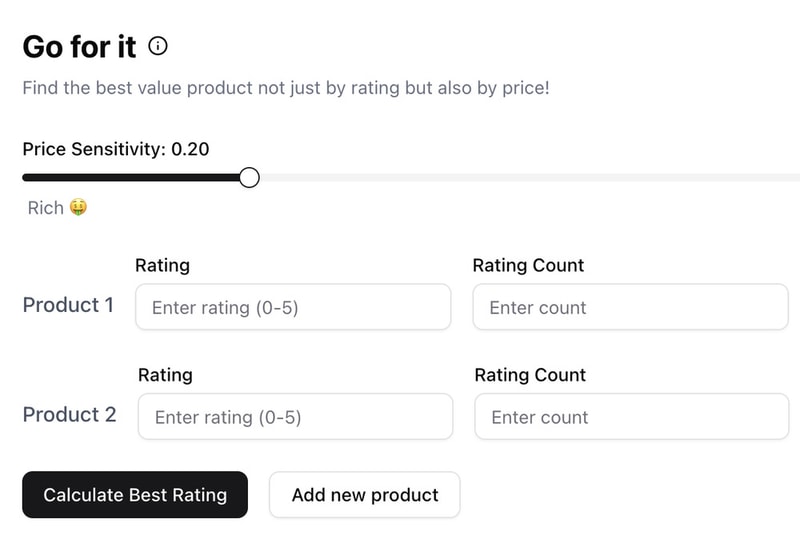
Go For It is a decision-support tool designed to assist users in selecting products based on data analysis rather than subjective judgment. It aggregates and evaluates key factors such as customer ratings, reviews, and pricing to identify options that offer the best overall value.
By structuring this information into a comparative framework, the tool helps users make more informed purchasing decisions without manually reviewing multiple sources. It is typically used by consumers and professionals seeking efficiency and objectivity in product selection, particularly in categories with a high volume of choices. Go For It reflects broader trends in data-driven decision tools, where algorithms are applied to simplify evaluation processes and reduce cognitive load. Its primary function is to translate dispersed consumer data into actionable insights for more rational and efficient purchasing behaviour.
Image Credit: Go For It
What's Driving This Trend
- Data-driven Decision Tools
- A shift toward algorithmic evaluation of multifactor data creates opportunities to replace subjective shopping with reproducible, scalable recommendation frameworks.
- Review Sentiment Aggregation
- Aggregating nuanced customer feedback into quantifiable sentiment scores enables new methods for distinguishing authentic product quality signals from noise.
- Price-quality Optimization
- Combining pricing dynamics with quality indicators paves the way for models that reveal true value propositions beyond simple lowest-price comparisons.
Who This Affects Most
- E-commerce Platforms
- Platform marketplaces can be transformed by integrated comparative tools that present objective value rankings alongside listings, altering buyer search behavior.
- Consumer Goods Manufacturing
- Manufacturers gaining access to aggregated review and pricing analytics can iteratively redesign products to target measurable value metrics rather than aesthetic trends.
- B2B Procurement Services
- Procurement workflows have the potential to shift toward automated supplier selection driven by consolidated performance, review, and price data rather than legacy relationships.