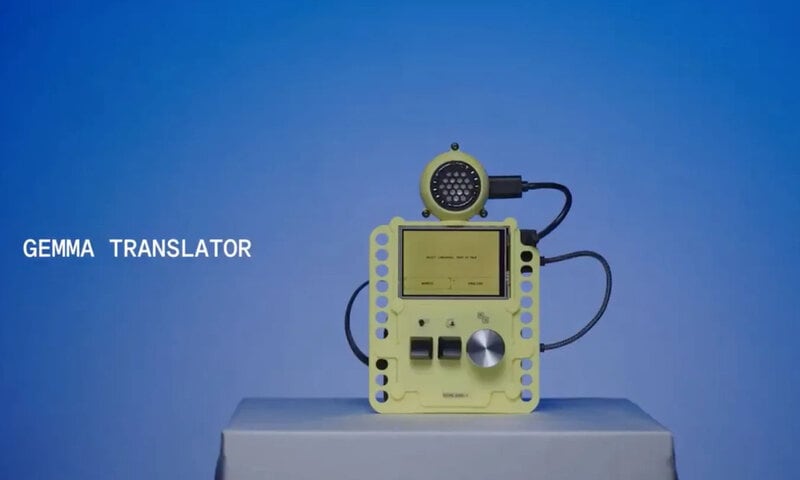
At the beginning of the year, Google announced TranslateGemma—a collection of open translation models built on Gemma 3 to help people communicate across 55 languages—and now, the company has introduced the Gemma Translator. Prototyped in collaboration with Antigravity, Gemma Translator is an AI translation tool that runs offline using Google's lightweight Gemma 4 E2B model.
Language barriers are one challenge on their own, but most translation tools compound the problem by requiring a stable internet connection. The Gemma Translator, housed within a custom 3D-printed enclosure, offers a different experience, thanks to Raspberry Pi 5, a microphone, and a speaker. As such, the self-contained offline AI translator that processes speech on-device has value for locations where connectivity is unreliable or for sensitive conversations that shouldn't have data sent to the cloud.
Key Themes Behind This Trend
- Offline Language AI
- On-device translation models create new value in travel, healthcare, and field services where connectivity gaps limit real-time communication.
- Privacy-first Speech Tools
- Local speech processing supports sensitive conversations by reducing dependence on cloud transmission and third-party data handling.
- Edge AI Hardware
- Compact AI devices built with lightweight models and low-cost components expand access to intelligent services in remote or constrained environments.
Where This Applies
- Travel Technology
- Portable offline translators improve cross-language communication for tourists, guides, and hospitality providers in areas with unreliable networks.
- Healthcare
- Private on-device interpretation enables multilingual patient interactions in clinics, emergency settings, and outreach programs without exposing sensitive data to remote servers.
- Education Technology
- Offline translation devices support language learning and classroom inclusion in schools where internet access is inconsistent or unavailable.