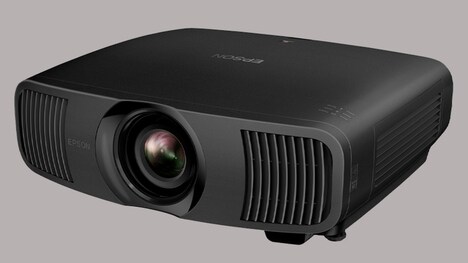
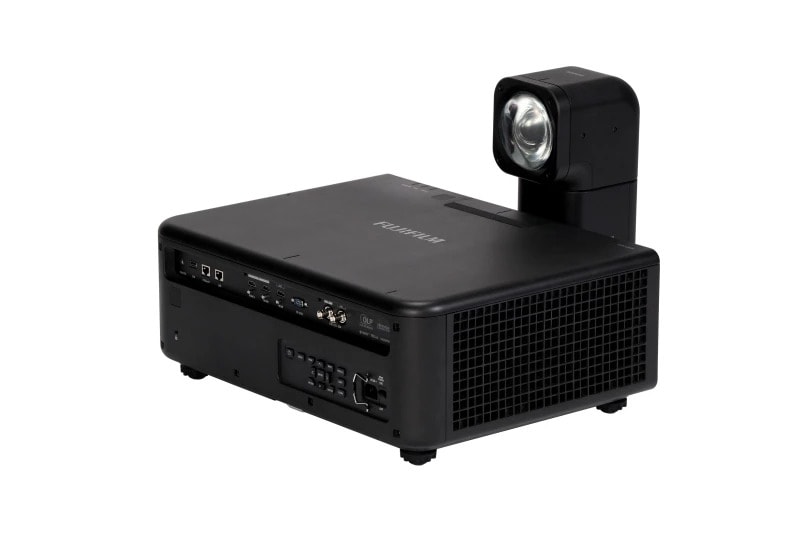
Fujifilm introduced the ZUH12000, a high-brightness business projector featuring a laser light source and an interchangeable lens system that supports 4K output. Launched as the brightest member of the Z-series, the unit pairs a compact rotating-lens body with selectable optics designed for different venue sizes and orientations.
At launch the ZUH12000 was offered with three lens modules: a flexible ultra-short-throw lens (FP-ZL034) with a 0.34–0.41 throw ratio that permits close placement and 360-degree head rotation, a short-throw FP-ZL050 (0.5–0.65) for mid-sized rooms, and a standard-throw FP-ZL125 (1.25–2.0) for rear or large-hall installations. Fujifilm also improved the optical engine for stronger color reproduction, greater contrast and broad connectivity including HDMI, HDBaseT and LAN.
For AV buyers and venue managers, the ZUH12000 makes it easier to standardize on one projector body while swapping lenses to suit spaces, reducing install complexity and equipment counts. Its 12,000-lumen output addresses ambient-light challenges in commercial environments and reflects a trend toward modular, adaptable pro AV hardware.
Image Credit: Fujifilm
Key Themes Behind This Trend
- Modular Optics Systems
- Interchangeable-lens architectures enable a single projector body to serve multiple projection scenarios, opening possibilities for hardware-as-a-platform business models.
- High-brightness Compact Projectors
- Compact units delivering 12,000+ lumens challenge the traditional size-output compromise, making bright projection viable in ambient-lit commercial environments.
- Venue-adaptive AV Standardization
- Standardized, swappable modules across AV deployments reduce custom install complexity and encourage third-party accessory ecosystems.
Where This Applies
- Pro AV Systems
- Systems integrators encounter shifting value propositions as modular projectors simplify inventory needs and elevate software and managed services.
- Event Venue Management
- Large venues and rental companies experience new provisioning flexibility from lens-swappable projectors that accommodate diverse room sizes and orientations.
- Education Technology
- Lecture halls and classrooms are positioned to adopt adaptable projection hardware that scales throw and brightness to varied learning spaces, affecting procurement and support models.