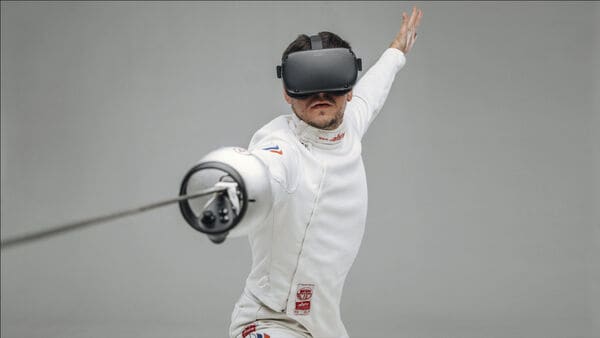
Created with aspiring fencers in mind, Fencer by Russian virtual reality studio Boxglass is a fencing trainer that helps players learn all the rules in an immersive setting. The rules of fencing are in accordance with the International Fencing Federation, which governs Olympic fencing, so the virtual experience accurately parallels real life.
With exercises focused on reaction and attention, attacking and defending, players will find that they are becoming better fencers as they duel. While a virtual headset is worn, would-be fencers are meant to use a real fencing sword, so that they can get a feel for moving with an object of the correct weight. As the studio describes, this plays an essential role in the formation of muscle memory and motor skills.
Image Credit: Boxglass
What Makes This Trend Stand Out
- Virtual Reality Training
- Fencer by Boxglass is one of the examples how virtual reality is transforming traditional sports training.
- Immersive Learning Experience
- The use of immersive technology like virtual fencing trainers is becoming a popular trend among sports enthusiasts.
- Sensory Integration Training
- Virtual fencing trainers are transforming how physical sports like fencing are learned through the integration of muscle memory and motor skills.
Sectors Adopting This
- Sports and Fitness Technology
- The use of virtual fencing trainers like Fencer by Boxglass has opened up opportunities for sports and fitness technology startups to innovate and develop similar products.
- Virtual Reality Gaming
- The success of virtual fencing trainers like Fencer by Boxglass can inspire game developers to create more immersive sports gaming experiences using virtual reality technology.
- Education Technology
- The use of virtual fencing trainers in education technology can revolutionize how physical sports are taught in schools and universities by providing an interactive and engaging learning experience.