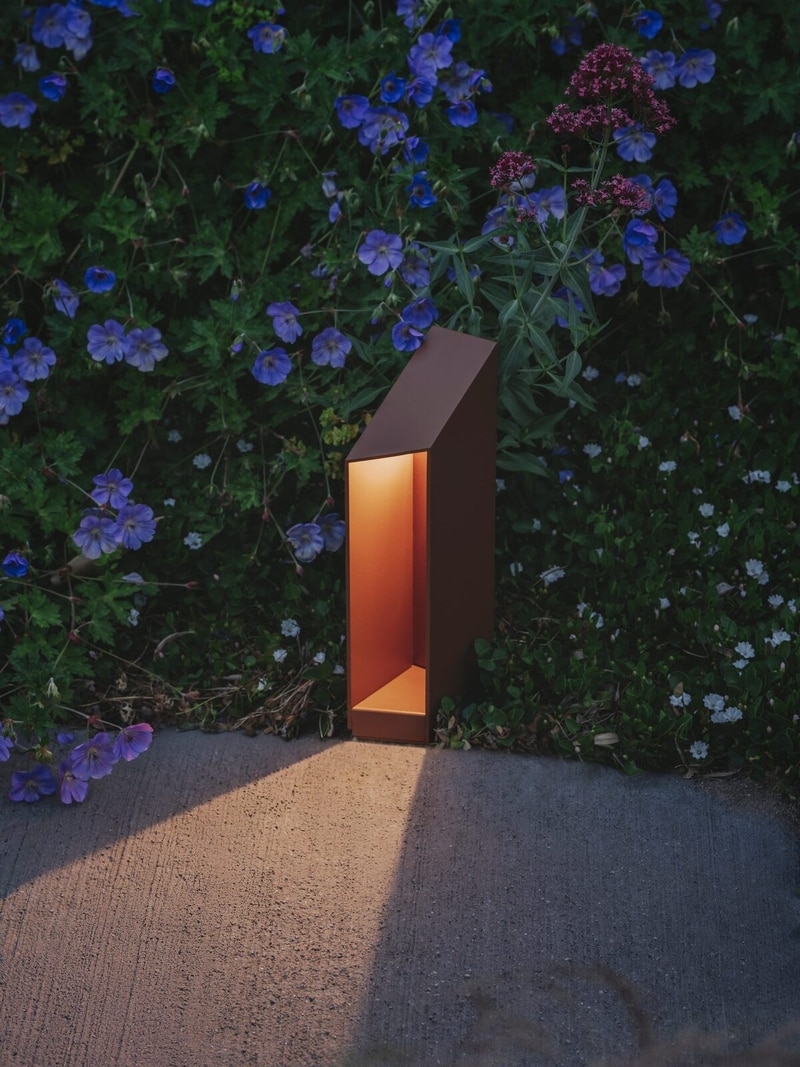
Domus outdoor lighting is a collection of bollard lights designed by Joan Gaspar for Spanish lighting brand Marset. The series draws inspiration from the appearance of houses illuminated from within, translating that idea into a family of architectural outdoor fixtures.
Constructed from aluminium and steel, each bollard features a distinctive asymmetrical profile with an angled opening that directs light outward while emphasizing the sculptural geometry of the form. The minimalist design combines clean linear surfaces with a silhouette intended to create visual interest both during the day and after dark.
The collection is available in heights of 26, 36, and 55 centimetres and can be installed as individual fixtures or grouped into larger arrangements. Multiple units can be combined in pairs or trios to create more sculptural lighting compositions within gardens, pathways, and outdoor public spaces. Marset offers the range in white, black, and rust-brown finishes to suit different landscape and architectural contexts.
Image Credit: Marset
Why This Trend Is Growing
- Asymmetrical Lighting Design
- Asymmetrical profiles that direct light outward create new aesthetic languages for exterior spaces and enable fixtures to function as both illumination sources and sculptural landmarks.
- Modular Bollard Systems
- Scalable collections of small fixtures that can be grouped into pairs or trios suggest configurable lighting platforms that adapt to different spatial rhythms and programmatic needs.
- Material-driven Finishes
- Finish options like rust-brown, black, and white point to opportunities for materials and coatings to convey contextual narratives and enhance longevity in varied environmental conditions.
Industries Being Reshaped
- Landscape Architecture
- Designers of outdoor environments could integrate sculptural bollards as compositional elements that simultaneously address wayfinding, ambience, and nighttime aesthetics.
- Urban Lighting Infrastructure
- City-scale lighting programs may adopt compact, modular bollards to create layered illumination strategies that reduce light clutter while accentuating pedestrian pathways.
- Hospitality and Real Estate
- Exterior lighting treatments tied to architectural identity have the potential to become value-add differentiators that influence guest perception and property branding.