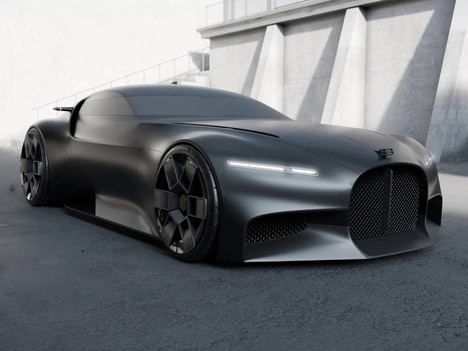
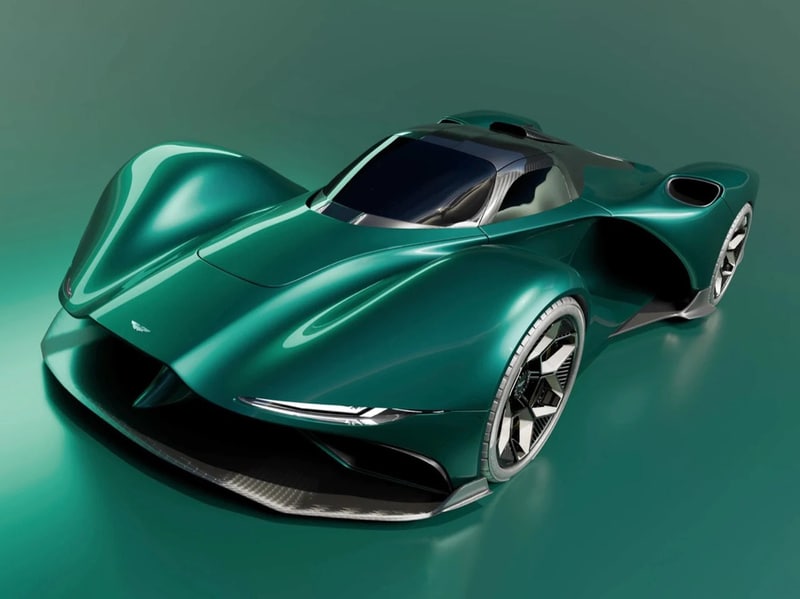
The Veil is a concept hypercar rendered by designer Hyunwoo Kim that reimagines Aston Martin’s post‑Valkyrie direction, featuring continuous, liquid‑metal surfaces rather than faceted carbon forms. The design was developed from paper mock‑ups into digital models, producing proportions and flowing transitions that read as organic sculpture. It appeared alongside Aston Martin F1 personnel, signaling interest from Gaydon and situating the Veil as a serious studio exploration.
Kim’s proposal emphasizes a central spine and massive rear fender volumes that form tunnels guiding air to a pronounced diffuser, with a canopylike one‑piece greenhouse and minimal front apertures for side‑mounted cooling. The layout suggests Le Mans Hypercar cockpit geometry and ground‑effect aero strategies, plus a vertical stabilizer integrated into the spine instead of a traditional wing. The approach prioritizes surface continuity, visible airflow channels, and sculptural presence over conventional hypercar ornamentation.
For consumers and enthusiasts the Veil matters as a stylistic and aerodynamic counterpoint to recent angular hypercars, showing how brands might balance elegance, electrification‑era cooling needs and downforce without resorting to aggressive creases. As a concept it signals a trend toward more seamless forms and function‑driven sculpture in advanced automotive studios.
Image Credit: Hyunwoo Kim
Why This Trend Is Growing
- Organic Surface Design
- The shift to continuous, liquid‑metal surfaces presents opportunities to reconceive vehicle aesthetics and aerodynamic performance as a unified, sculptural skin.
- Integrated Aerodynamic Spines
- Central spine architectures that channel airflow and embed stabilizing elements open possibilities for rethinking underbody tunnels and vertical control surfaces as structural aero components.
- Sculptural Electrified Cooling
- Minimal apertures combined with side‑mounted cooling pathways suggest novel thermal management strategies that integrate heat exchange into the vehicle’s form rather than surface clutter.
Industries Being Reshaped
- Automotive Design Studios
- Studio practices that prioritize paper‑to‑digital sculpting workflows can disrupt conventional concept-to-production pipelines by enabling more fluid, form-driven engineering collaborations.
- Aerospace Aerodynamics
- Knowledge of ground‑effect strategies and integrated stabilizers could translate into unconventional lift and control solutions for high‑speed terrestrial or low‑altitude aerospace platforms.
- Advanced Materials Manufacturing
- New fabrication techniques for seamless, continuous exteriors create potential for producing complex, load‑bearing surfaces that combine structural integrity with refined surface finish.