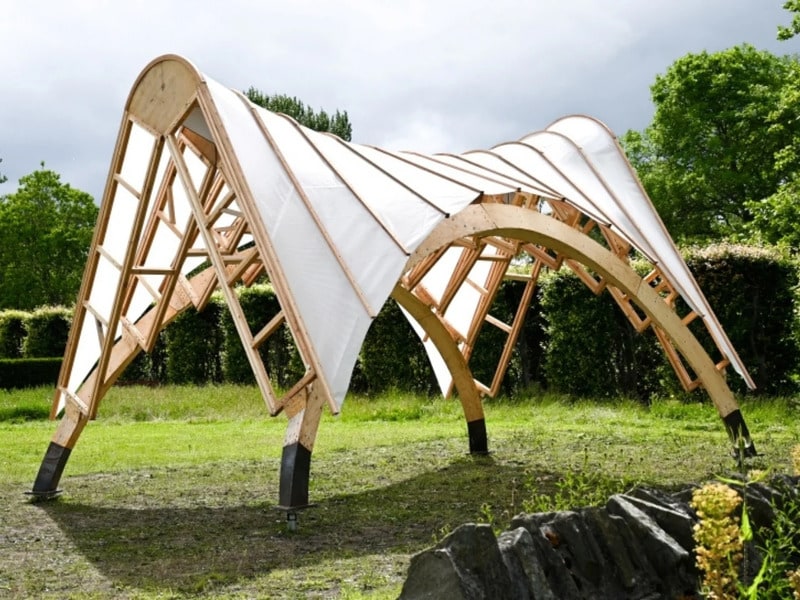
Arkhive is a full-scale timber pavilion developed by students from the Design for Manufacture program at University College London’s Bartlett School of Architecture. The pavilion was assembled using industrial robotic arms with precision fitting to explore sustainable construction approaches. The structure’s components are connected using reversible joinery rather than traditional fasteners, allowing each timber element to be taken apart and reassembled into new configurations without material loss.
The modular components fit together in a systematic arrangement that prioritizes adaptability. The project was installed at St Andrews Botanic Garden in Scotland in summer 2025 and served as an event and gathering space during its exhibition period. The Arkhive pavilion integrates robotics and sustainable design thinking through both fabrication and on-site assembly. The use of robotic precision was paired with timber elements designed to work within a disassembly-friendly system.
Image Credit: Design for Manufacture, Bartlett School of Architecture, University College London
Why This Trend Is Growing
- Sustainable Modular Architecture
- Designing structures with reconfigurable components opens avenues for environmentally friendly architecture through material conservation.
- Robotics-assisted Construction
- Utilizing industrial robotic arms in construction facilitates precision and efficiency, reducing reliance on traditional building methods.
- Reversible Joinery Systems
- Incorporating reversible joinery systems into design allows for easy disassembly and reconfiguration, enhancing flexibility and reducing waste.
Industries Being Reshaped
- Construction Technology
- Emerging construction technologies such as robotics and adaptive materials revolutionize building processes and project execution.
- Sustainable Design
- Innovations in sustainable design, including modular and recyclable components, address growing environmental concerns in the industry.
- Architectural Education
- Architectural education that emphasizes cutting-edge techniques prepares future architects for a paradigm shift towards sustainability and smart construction.