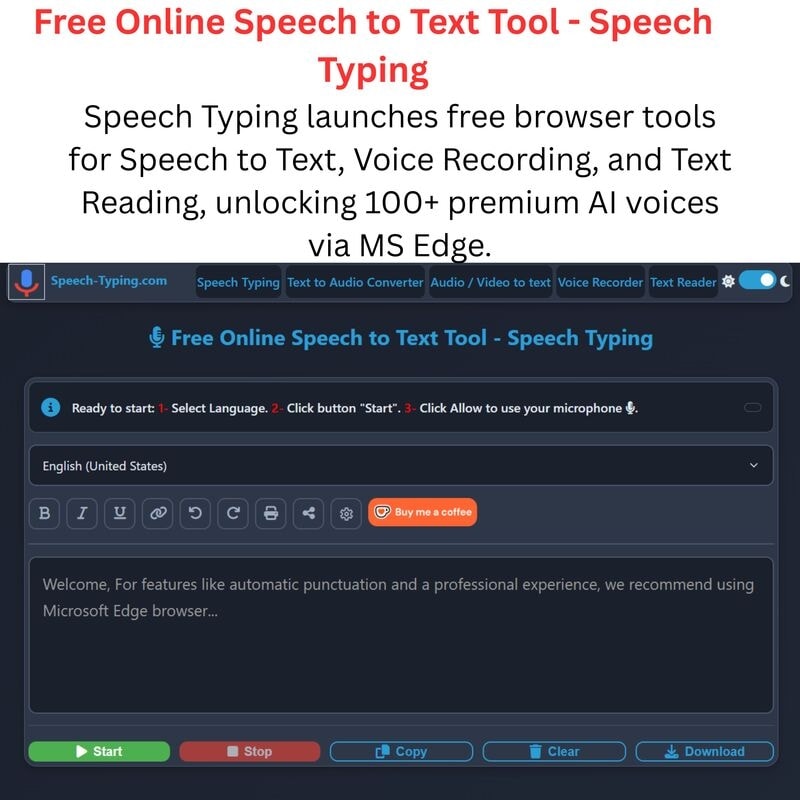
Speech Typing delivers "free browser tools for Speech to Text, Voice Recording, and Text Reading." This means that users can gain access to utilities for converting spoken words into written text, recording audio, and transforming written content into synthesized speech. The stated mission of the service is to lower financial and technical obstacles for individuals who rely on such assistive technologies for work, education, or content creation.
With an emphasis on democratizing digital accessibility, Speech Typing's service operates directly within a web browser without necessitating software installation or user registration. When accessed through the Microsoft Edge browser, the all-in-one platform can utilize a wider selection of over one hundred advanced artificial intelligence voices for its text-to-speech function.
Speech Typing's tool leverages contemporary web application programming interfaces to process audio locally on the user's device, where possible, which is presented as a benefit for data privacy.
Image Credit: Speech Typing
Why This Trend Is Growing
- Web-based Assistive Technology
- The shift towards web-based solutions enhances accessibility by removing installation barriers, enabling broader user reach.
- AI-driven Text-to-speech Solutions
- Advanced AI voices in text-to-speech functions are transforming user experiences by offering more natural and diverse auditory representations.
- Local Audio Processing for Privacy
- Processing audio locally on devices addresses privacy concerns, setting new standards for secure data management in digital tools.
Industries Being Reshaped
- Assistive Technology Industry
- Integrating multifunctional tools into web platforms expands the ability of assistive technology solutions to cater to diverse user needs.
- Web Application Development
- The demand for browser-based applications without installation showcases the growing importance of seamless and direct user access in software design.
- Artificial Intelligence in Audio Tools
- Innovations in AI that enhance voice synthesis capabilities provide opportunities for developing more intuitive and efficient auditory interfaces.