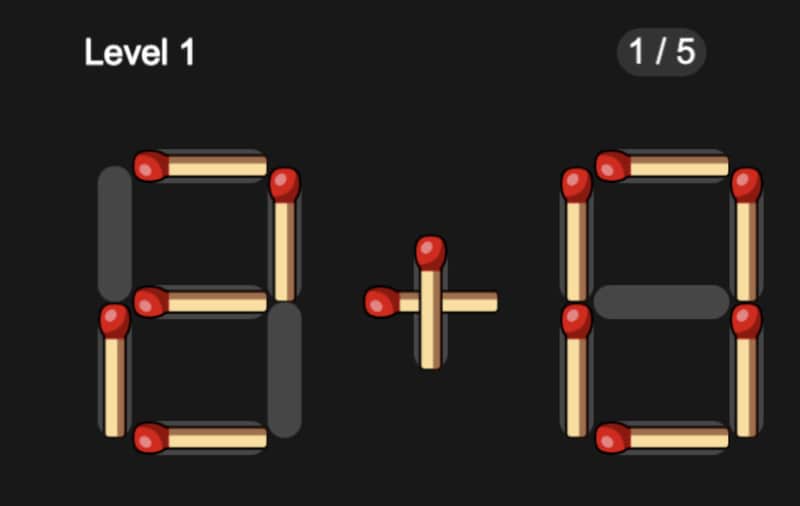
Mathstick is a digital puzzle game that modernizes the classic matchstick puzzle concept. Players are presented with mathematical equations represented using matchsticks and must move a single stick to correct the equation. The game gradually increases in difficulty, challenging users’ logical reasoning and problem-solving abilities. Its minimalist design focuses purely on cognitive engagement without unnecessary distractions, making it accessible for both casual players and enthusiasts of logic puzzles.
From a business or educational perspective, Mathstick demonstrates how traditional problem-solving exercises can be adapted to digital formats, offering potential applications in learning, brain training, and gamified logic challenges. The game’s structure provides measurable progression in skill level, which can be leveraged to study cognitive development patterns or to engage audiences in skill-based competitive contexts.
Image Credit: Mathstick
Key Themes Behind This Trend
- Gamified Cognitive Training
- A surge in games that translate cognitive exercises into engaging, progress-tracked experiences could redefine how users perceive and invest time in skill development.
- Minimalist Puzzle Design
- Stripping interfaces to a bare cognitive core is enabling products that prioritize deep focus and measurable improvement over attention-hungry features.
- Adaptive Single-move Mechanics
- Puzzles that require one precise change to alter outcomes introduce scalable complexity and new metrics for assessing problem-solving expertise.
Where This Applies
- Educational Technology
- Digital adaptations of classic problem sets are creating tools that can personalize learning pathways and provide empirical data on student reasoning patterns.
- Neurofitness and Brain Training
- Cognitive games with incremental difficulty and clear scoring are positioning themselves as measurable platforms for tracking and enhancing mental acuity across demographics.
- E-sports and Competitive Gaming
- Skill-based puzzle titles with progression systems are forming spectatorship-friendly formats that bridge casual play and organized competitive events.