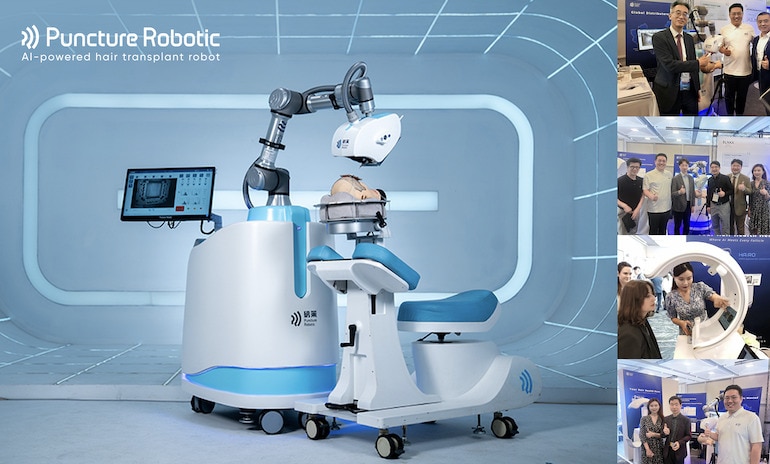
Puncture Robotic showcased its HAIRO Hair Transplant Robot at the 14th World Congress for Hair Research. The company presented an AI-driven ecosystem that integrates intelligent hair assessment, surgical planning, robotic execution, and postoperative management within a single platform. This innovation is positioned as a significant advancement in the automation of follicular-unit extraction procedures.
Puncture Robotic's HAIRO Hair Transplant Robot, which has received NMPA Class III certification in China, employs 20-megapixel binocular cameras and millisecond-level image processing to achieve sub-surface positioning accuracy of 0.1 millimeters. This enables physicians to perform extractions with a level of precision that minimizes damage to surrounding tissue while maintaining a follicular-unit damage rate below 7.5 percent under specified conditions. A proprietary 'Single-Hair Skipping' algorithm distinguishes between multi-hair and single-hair follicular units, prioritizing the extraction of the former
Image Credit: Puncture Robotic
Key Themes Behind This Trend
- AI-guided Surgical Robotics
- Precision robotics paired with real-time imaging is reshaping elective procedures by reducing variability, improving clinical consistency, and expanding access to specialist-level outcomes.
- Integrated Aesthetic Care Platforms
- End-to-end systems that combine assessment, planning, procedure automation, and recovery management create new value in personalized cosmetic treatment journeys.
- Micro-precision Tissue Extraction
- Sub-millimeter targeting and intelligent follicle selection introduce opportunities for minimally invasive interventions that preserve surrounding tissue and improve patient recovery profiles.
Where This Applies
- Medical Robotics
- Advanced robotic platforms are moving beyond hospital operating rooms into specialized outpatient procedures, creating growth potential for compact, AI-enabled clinical systems.
- Aesthetic Medicine
- Automation and data-driven personalization are elevating cosmetic services by making premium procedures more predictable, standardized, and scalable across clinics.
- Digital Health
- Postoperative monitoring and intelligent treatment management software can extend procedural care into connected recovery ecosystems that strengthen patient engagement and outcomes.