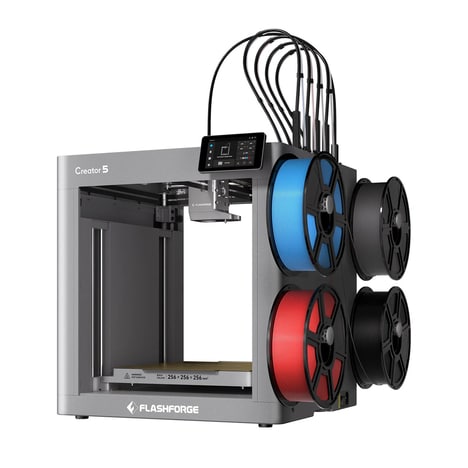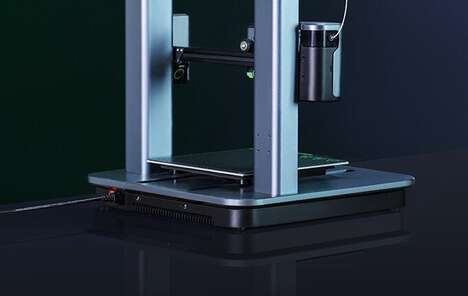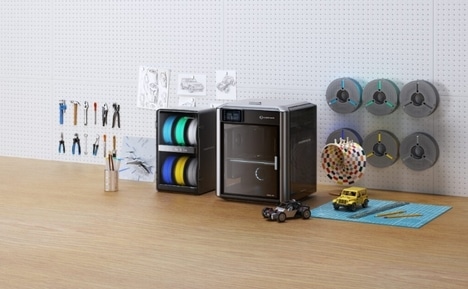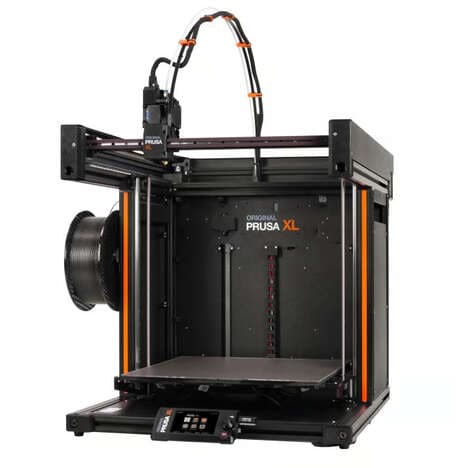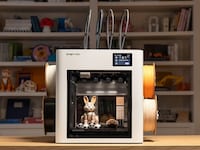
The Snapmaker U1 Color 3D Printer is a forthcoming 3D printing system. This product, currently being funded through Kickstarter, is distinguished by its innovative use of four independent, pre-heated toolheads that can be swapped automatically in approximately five seconds.
The Snapmaker U1 Color 3D Printer's design fundamentally addresses two significant inefficiencies common in multi-material printing — extensive purge waste and prolonged printing durations. Snapmaker maintains that its innovation can reduce waste by up to 80% and that its machine is capable of travel speeds up to 500mm/s while "maintaining long-term precision across a 270 × 270 × 270mm work area."
The advanced 3D printing technology incorporates advanced motion control systems, including Input Shaping and Pressure Advance, to maintain print quality at high speeds and ensure precise alignment across all toolheads. The system is also equipped with an automatic filament handling system, comprehensive sensor-based error detection, and remote monitoring and control via a dedicated application.
Image Credit: Snapmaker
What Makes This Trend Stand Out
- Color-integrated 3D Printing
- The introduction of color-integrated 3D printing systems marks a shift towards more versatile and visually dynamic print outputs, challenging traditional monochrome limitations.
- Automated Toolhead Switching
- Automated toolhead switching in 3D printers significantly enhances efficiency by reducing equipment downtime and manual intervention.
- Advanced Motion Control Systems
- Advanced motion control systems in 3D printing allow for higher speed and precision, paving the way for faster production cycles without sacrificing quality.
Sectors Adopting This
- Additive Manufacturing
- Recent advancements in additive manufacturing, such as independent toolhead systems, are driving a new era of rapid custom production.
- Smart Industrial Tech
- Smart industrial technology solutions, like sensor-based error detection in 3D printers, are optimizing operational reliability and output accuracy.
- Iot in Manufacturing
- Internet of Things (IoT) integration in manufacturing facilitates enhanced remote monitoring and control, transforming how production processes are managed and optimized.