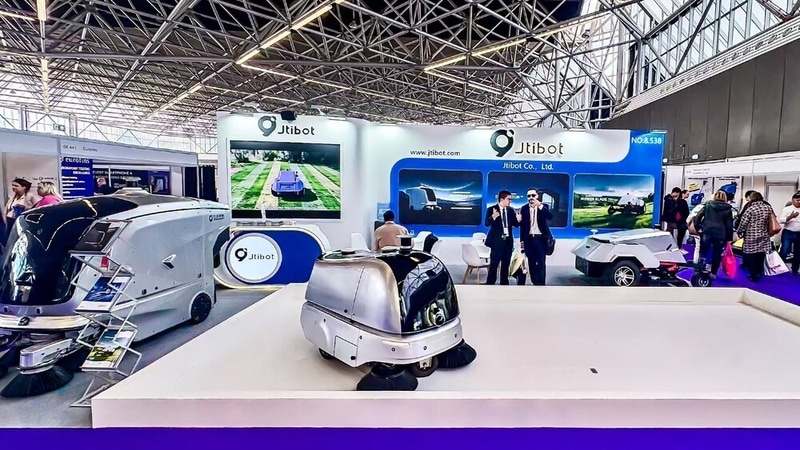
Jtibot showcased its autonomous outdoor sweeper at Interclean Amsterdam 2026. This robotic cleaning system is designed for large-scale environments exceeding 10,000 square meters and, as such, it specifically targets industrial sites, municipal areas, and university campuses.
Jtibot's autonomous outdoor sweeper uses AI-driven navigation to perform sweeping tasks without constant human operation. This positions the innovation between traditional heavy equipment and smaller experimental robots. The company maintains that its solution embraces human-machine collaboration rather than full replacement of workers. Steven, VP at Jtibot, confirms this: "As outdoor environments continue to grow in scale and complexity, automation is becoming essential. Our goal is not to replace people, but to empower them—making operations more efficient and labor more sustainable."
Jtibot mentioned that during the Interclean Amsterdam 2026 showcase, its innovation "attracted strong interest from European distributors and facility management professionals seeking scalable solutions for large-area maintenance."
Image Credit: Jtibot
Why This Trend Is Growing
- Scale-focused Autonomous Maintenance
- Fleet-level autonomy for sweeping across areas exceeding 10,000 square meters enables centralized scheduling, utilization analytics, and cost-per-area benchmarking.
- AI-powered Navigation for Outdoor Robotics
- Advanced perception and route-planning algorithms allow outdoor robots to handle complex, dynamic environments with reduced supervision and higher uptime.
- Human-machine Collaborative Facilities Management
- Hybrid workflows that pair autonomous equipment with human oversight create opportunities for skill-shift roles and mixed labor-robot teams in maintenance operations.
Industries Being Reshaped
- Municipal Services
- Public works departments could leverage autonomous sweepers to standardize street and park cleanliness metrics while optimizing budgeted labor hours.
- Industrial Site Operations
- Large manufacturing and logistics campuses stand to gain from predictable, continuous outdoor cleaning that reduces contamination risks and supports safety compliance.
- Higher Education Campus Facilities
- University grounds maintenance could benefit from scalable robotic fleets that maintain extensive outdoor spaces while freeing staff for specialized tasks.