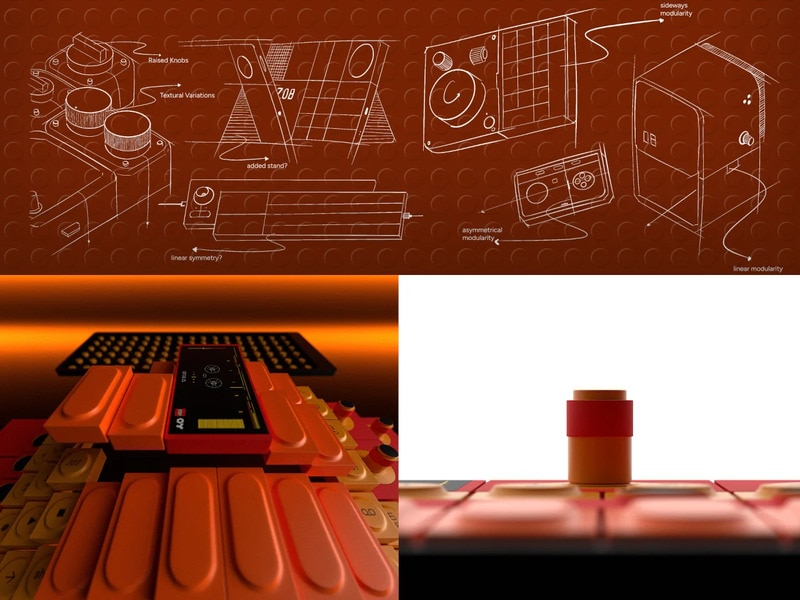
The Synth modular controller by Madhav Binu is a concept interface that reimagines electronic music performance and sequencing as a block-based, modular process. The controller consists of a series of interlocking tactile modules that each represent a specific sound element or function, enabling users to combine, rearrange, and stack blocks to create custom signal chains and musical structures.
Each module houses a discrete control surface with knobs, faders, or touch-sensitive paths that correspond to parameters like pitch, filter, envelope, and effects. The modules connect physically through magnetic or slide-in mechanisms, allowing real-time rearrangement during composition or live performance. The concept envisions a seamless blend between hardware intuition and modular synthesis flexibility without requiring patch cables or software menus. The design renders depict a compact base plate that powers the blocks, LED feedback for active status, and ergonomic spacing that facilitates both desktop and live use.
Image Credit: Madhav Binu
Key Themes Behind This Trend
- Block-based Instrument Design
- A plug-and-play block system reframes instrument configuration as physical assembly, enabling bespoke signal chains without software navigation.
- Magnetic Modular Connectivity
- Removable magnetic or slide-in connections create a reconfigurable hardware topology that shortens setup time and encourages on-the-fly sonic experimentation.
- Tactile Parameter Sculpting
- Dedicated mini control surfaces per block surface a hands-on approach to sound shaping that reduces reliance on menus and visual displays.
Where This Applies
- Live Music Performance
- Stage rigs could adopt compact modular controllers that allow performers to restructure sets mid-show while maintaining robust tactile feedback.
- Electronic Instrument Manufacturing
- Producers of synthesizers and controllers might pivot toward interoperable hardware modules that extend product lifecycles through incremental add-ons.
- Music Education Technology
- Educational tools could leverage block-based interfaces to teach synthesis and sequencing through intuitive physical assembly rather than abstract theory.