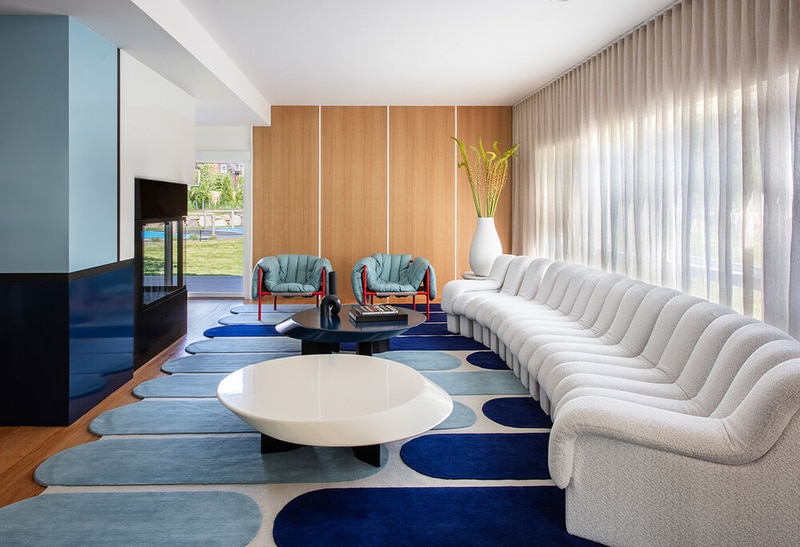
The Long Island Home by Shanna Gatanis Design Studio is a 12,000-square-foot residence originally conceived as a minimalist white interior, later transformed into a saturated, color-driven environment. Set on a wooded hill, the project reworks a neutral architectural shell into a layered interior defined by bold hues and contrasting materials. Blues anchor the spaces, while reds, yellows, and greens are distributed throughout rooms to create rhythm and variation across the layout.
The interiors combine terrazzo, lacquered finishes, colored glass, and warm wood to build depth without relying on ornament. Programmatically, the house shifts between open entertainment areas and more private family zones, extending into amenities such as a basketball court, music lounge, pool, and flexible outdoor spaces. Graphic elements, including a Lego-inspired fireplace and mural references to hip hop culture, are integrated into the architecture
What Makes This Trend Stand Out
- Color-as-structure Interiors
- A saturation-first design approach that treats color as an organizing system rather than decoration opens potential for products and systems that encode function, flow, and identity through hue.
- Material Mashup Surfaces
- Combining terrazzo, lacquer, colored glass, and warm woods in deliberate contrasts signals demand for hybrid surface systems that integrate aesthetics, acoustics, and durability in single assemblies.
- Programmatic Zoning Through Color
- Using distinct palettes to delineate entertainment, private, and amenity zones suggests new paradigms for adaptive spatial programming where color controls perception and behavioral flows.
Sectors Adopting This
- Residential Architecture
- Bold, color-driven interiors indicate opportunities for architecture firms to offer specification-led packages that redefine spatial hierarchy and client identity within homes.
- Interior Finishes Manufacturing
- A shift toward integrated, vividly colored materials points to a market for prefabricated, color-calibrated finish systems that simplify installation while preserving design intent.
- Experience-driven Real Estate
- Properties emphasizing curated, culture-referential interiors reveal potential for developers to differentiate listings through sensory-rich design narratives that target lifestyle-minded buyers.