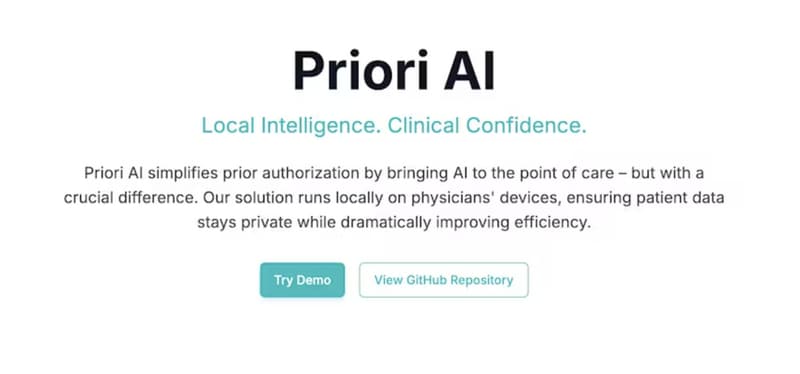
Priori AI operates within the healthcare operations technology sector, focusing on the prior authorization process between providers and insurers. This workflow is often cited as a bottleneck in care delivery due to its administrative complexity and variability across payers.
From a business perspective, Priori AI reflects a broader push toward automation in healthcare back-office functions, where efficiency gains can directly impact both cost and patient experience. By positioning itself around “local intelligence” and “clinical confidence,” it suggests a hybrid approach combining data processing with domain-specific decision support. Its value lies in reducing manual review cycles and standardizing authorization workflows. However, its adoption trajectory will likely depend on regulatory alignment, interoperability with existing health systems, and trust in AI-assisted clinical decision processes within highly regulated environments.
Image Credit: Priori AI
Key Themes Behind This Trend
- Automation of Prior Authorizations
- Streamlining authorization approvals through AI-driven automation can significantly shorten decision timelines and alter administrative staffing models.
- Hybrid Local Clinical Intelligence
- Combining localized clinical rules with machine learning models enables context-aware recommendations that can reshape vendor differentiation and trust dynamics.
- Standardization of Authorization Workflows
- Reducing variability across payers by codifying common authorization rules and data formats has the potential to simplify integrations and lower transaction costs.
Where This Applies
- Health Insurance Payers
- Insurers adopting AI-assisted authorization platforms may experience altered risk assessment processes and novel cost-containment levers.
- Hospital Operations and Health Systems
- Clinical operations teams integrating automated prior authorization tools could see care throughput changes and redeployment of administrative resources.
- Health IT Interoperability Platforms
- Middleware and EHR vendors enabling standardized data exchange for authorization decisions stand to become central hubs in care coordination ecosystems.