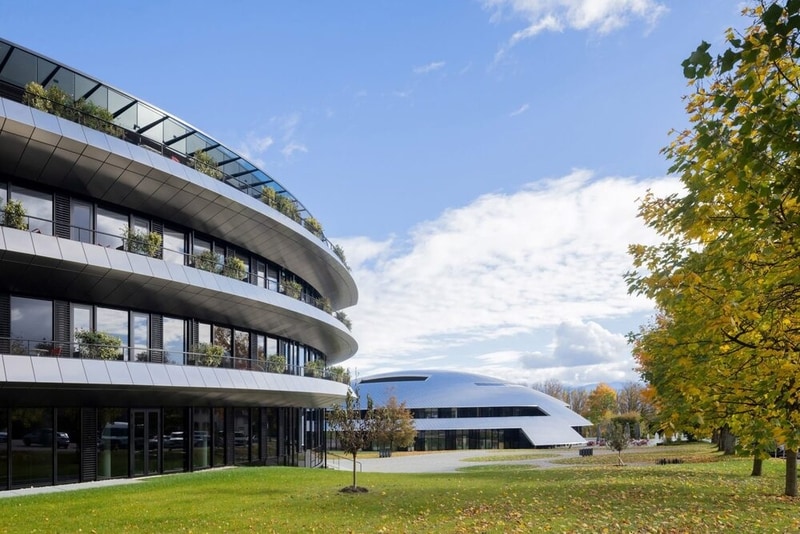
Philo by Bernard Tschumi Architects is a circular education building completed in 2025 on the Institut Le Rosey campus in Rolle, Switzerland. The project is designed as a hub for student innovation, organizing classrooms, labs, and collaborative spaces around a central atrium that acts as a covered public plaza. Circulation is a key feature, with intersecting horizontal and vertical pathways, a spiral staircase, and double-helix slides activating movement through the interior.
The building spans five levels and includes programs such as a fabrication lab, startup incubator spaces, and presentation areas, all supported by movable partitions that allow flexible spatial configurations. Its material palette combines steel, concrete, wood, and glass, aligning with adjacent campus buildings while maintaining a distinct identity. A domed roof with electrochromic glazing controls light and heat.
Image Credit: Iwan Baan
What's Driving This Trend
- Flexible Modular Learning Spaces
- Movable partitions and reconfigurable rooms create adaptable pedagogical environments that can merge classrooms, labs, and incubation zones for multi-use programming.
- Kinetic Circulation Design
- Spiral staircases, double-helix slides, and intersecting pathways transform movement into a programmatic element that enhances social interaction and informal learning moments.
- Adaptive Glazing and Environmental Control
- Electrochromic dome glazing integrated with material diversity enables dynamic daylighting and thermal modulation that respond to occupancy and climatic conditions.
Who This Affects Most
- Education Technology
- Integrated fabrication labs and startup incubators within the school setting signal platforms for immersive maker curricula and embedded entrepreneurship networks.
- Architectural Engineering
- Combining steel, concrete, timber, and advanced glazing invites novel structural systems and performance-driven facades that reconcile aesthetic cohesion with energy targets.
- Modular Construction and Fabrication
- Movable partitions and multi-level program stacks indicate opportunities for prefabricated, reconfigurable components that shorten build cycles and enable iterative campus upgrades.