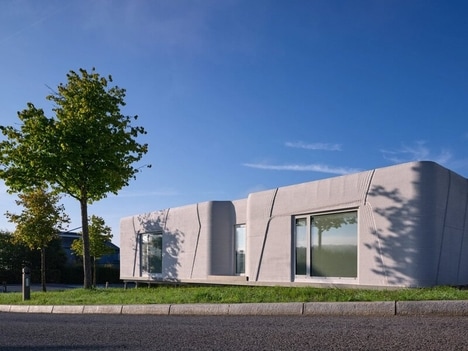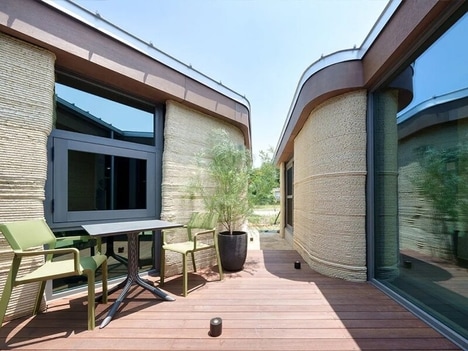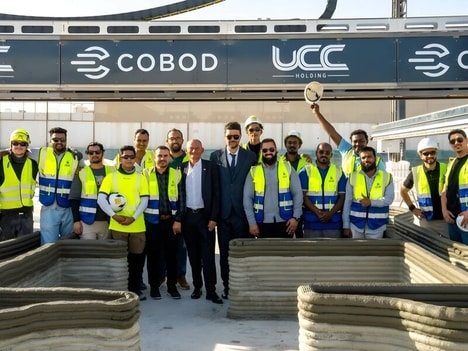
Japan’s 'O House' is a two-story residence created by Kizuki and Onocom, produced using a COBOD 3D printer and designed with cave-like geometry, featuring arched walls and skylights. The 50 sq m (537 sq ft) structure combined on-site robotic extrusion of a cementitious mix with conventional concrete elements.
The build used a hybrid approach: 3D-printed shell components were integrated within a reinforced concrete frame and anchored by a reinforced strip foundation plus ground-improvement piles to meet Japan’s strict seismic codes. A four-person crew operated the printer from a base 0.5 m below ground up to 7 m high, and interiors include curved cabinetry and an upside-down layout with living spaces upstairs.
As a demonstration model, O House showed that 3D-construction printing can achieve structural precision for seismic regions, pointing to future use in housing projects and post-disaster rebuilds where rapid, geometry-driven builds matter to occupants and planners.
Image Credit: Onocom
Why This Trend Is Growing
- Geometry-driven Architectural Forms
- Novel cave-like arches and curved shells demonstrate how complex geometries can enable new spatial efficiencies and aesthetic differentiation in mass-produced housing.
- Hybrid Robotic-conventional Construction
- By combining on-site 3D printing with reinforced concrete frames, hybrid workflows suggest pathways to meet stringent safety codes while leveraging automation for speed and customization.
- Seismic-resilient 3D Printing
- Seismic-compliant printed shells anchored to reinforced foundations indicate potential for affordable, code-ready prefabricated components in earthquake-prone regions.
Industries Being Reshaped
- Residential Housing Development
- Curved, rapidly produced printed shells could shift cost and design paradigms, enabling developers to offer distinctive, lower-labor homes at scale.
- Disaster Relief and Reconstruction
- Post-disaster scenarios could benefit from geometry-driven rapid builds that provide durable, quickly deployable shelters tailored to local seismic requirements.
- Construction Robotics and Materials
- Advances in cementitious extrusion and integrated robotics point toward new product lines for printers, materials, and software that support precise, code-compliant construction.