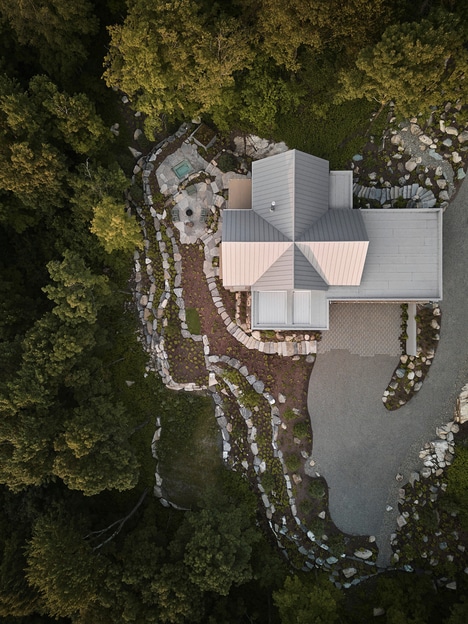
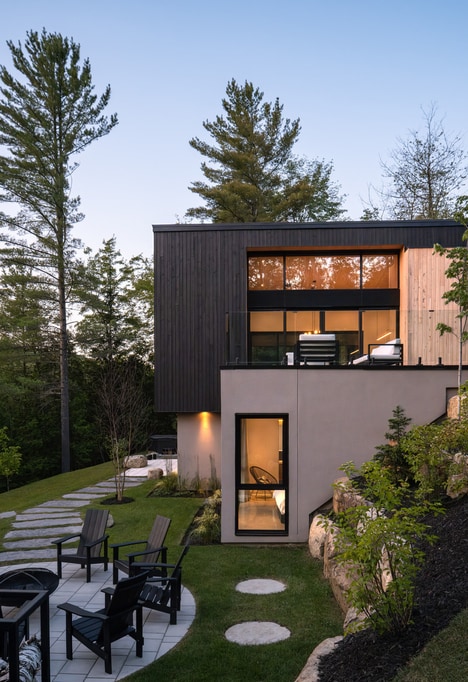
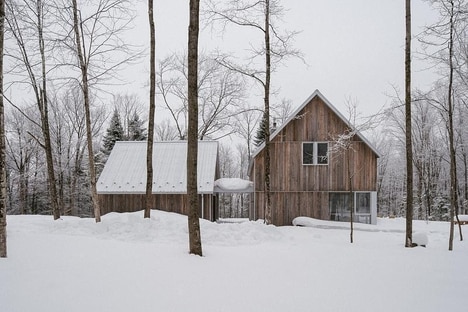
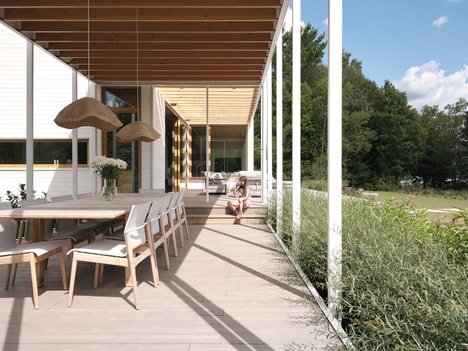
Matière Première Architecture has completed a residential project named Perchée in North Hatley, Canada. The house is designed to sit suspended within a gently sloping, maple-wooded site. The architects worked to preserve the mature trees in the ecosystem and the immersive feeling of being among them.
As part of the Perchée project, Matière Première Architecture extended floors and roof planes to act as precise framing instruments that carve out only the necessary space around the building. A longitudinal cantilever reduces excavation close to the building, thereby protecting tree root systems.
Inside, ten-foot ceilings and a 30-inch clerestory band detach partitions from the roof plane, letting light and sightlines flow freely between rooms, while generous roof overhangs filter harsh summer sun but welcome low winter light. Material choices include select spruce from Northern Quebec forests for interior warmth, red cedar for larger structural elements, and white cedar treated with a weathering accelerator for the building envelope,
Image Credit: Ian Balmorel
Key Themes Behind This Trend
- Tree-conscious Site Design
- Designs that prioritize preservation of mature trees and root systems create opportunities for construction methods that minimize excavation and reframe the building-to-land relationship.
- Minimal-intervention Construction
- A movement toward extending structural planes and cantilevers to carve out only necessary space points to new prefabricated and adaptive structural systems that reduce on-site disturbance.
- Passive Light and Climate Strategies
- Integration of clerestory bands, deep overhangs and seasonal solar modulation signals potential for refined building envelopes that balance daylighting with thermal comfort without heavy mechanical systems.
Where This Applies
- Residential Architecture
- Residential architecture is being reshaped by designs that embed homes within existing ecosystems, prompting novel spatial typologies and client expectations for low-impact living.
- Sustainable Timber Supply
- Sustainable timber supply chains face demand for regionally sourced, certified softwoods and weathering-treated materials that support both aesthetic warmth and durable building envelopes.
- Landscape and Urban Ecology
- Landscape and urban ecology practices are evolving to incorporate building-scale root and canopy protections, enabling new service models around integrated ecosystem stewardship for developed sites.