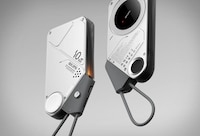
The MUSE AI music modules listen when you hum, tap, or strum not type by offering a series of dedicated hardware units that respond to live musical input rather than text prompts. Developed by Hyeyoung Shin and Dayoung Chang, MUSE is designed as a next-generation system for band musicians, with individual modules for vocals, drums, bass, synthesiser and electric guitar that each interpret playing gestures and sonic ideas in real time. When a user hums a melody, taps a rhythm, or strums a chord, the corresponding module analyses timing, touch and phrasing to generate complementary parts and variations that match the performance without relying on keyboard-based commands.
Each module operates independently, enabling musicians to position units around a room rather than centralising them on a computer workstation. The modules are shaped as small, colour-coded objects meant to sit alongside instruments, encouraging spontaneous musical interaction and exploration.
Image Credit: Hyeyoung Shin, Dayoung Chang
Why This Trend Is Growing
- Gesture-based Musical Interaction
- The shift from keyboard inputs to gesture-based interaction is transforming the way musicians create and collaborate, allowing real-time creative expression through hums, taps, and strums.
- Decentralized Music Production Systems
- Music production setups are moving away from centralized computer workstations, fostering a more organic and intuitive method of music creation by spreading modules across space.
- AI-enhanced Live Performance
- AI modules that enhance live performances by analyzing musical inputs open up new avenues for musicians to experiment and adapt dynamically during shows.
Industries Being Reshaped
- Music Technology
- The advent of gesture-responsive AI modules presents a potential leap in music technology, enhancing the way instrumental interfaces advance creative processes.
- Artificial Intelligence
- Implementing AI that processes non-textual inputs like musical gestures represents a growing focus on integrating machine learning with sensory-specific data.
- Live Entertainment
- The integration of AI modules capable of real-time response to musical cues could revolutionize live performances, offering entertainers more flexibility and creativity on stage.