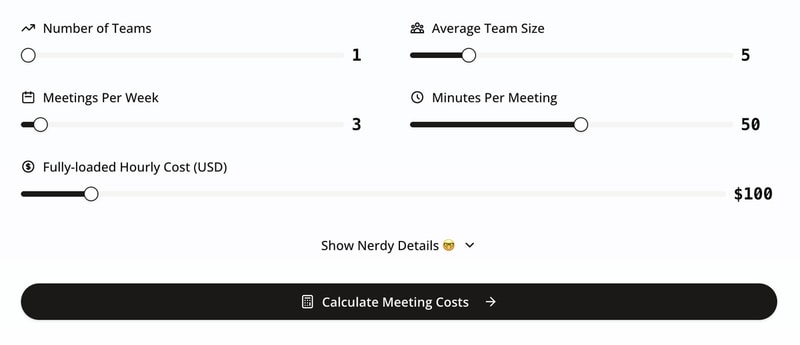
The Meeting Waste Calculator helps quantify the financial impact of workplace meetings by translating time spent in discussions into estimated monetary cost. It calculates how much meetings are costing your company -- based on participants, duration, and frequency -- and presents the result as a unified view of “meeting waste.”
Many organizations struggle to see the hidden cost of recurring meetings, where small sessions accumulate into significant productivity loss over time. This tool frames that problem in financial terms, making inefficiencies more visible to decision-makers and teams responsible for planning workflows.
By aggregating attendance and time inputs, the calculator provides a structured estimate of total meeting expenditure. It is positioned as a diagnostic tool for understanding how internal collaboration time translates into operational cost -- offering a clearer perspective on how organizational time is being consumed.
Image Credit: Meeting Waste Calculator
Why This Trend Is Growing
- Meeting Cost Transparency
- Financially quantified collaboration time reveals hidden productivity drains and creates space for analytics platforms that make operational inefficiency visible in real time.
- Workflow Efficiency Diagnostics
- Data-driven assessments of recurring meetings highlight the growing potential for tools that benchmark team processes against measurable cost and output indicators.
- Productivity Waste Analytics
- The conversion of employee time into monetary impact signals demand for enterprise dashboards that connect daily work patterns with broader business performance metrics.
Industries Being Reshaped
- Enterprise Software
- Collaboration and workforce platforms are positioned to integrate cost-estimation features that transform meeting management into a measurable productivity intelligence layer.
- Human Resources Technology
- People operations systems can use meeting-cost data to better understand employee workload, engagement friction, and organizational design inefficiencies.
- Management Consulting
- Advisory firms gain new analytical inputs from quantified meeting waste, supporting more evidence-based approaches to restructuring collaboration models and operational routines.