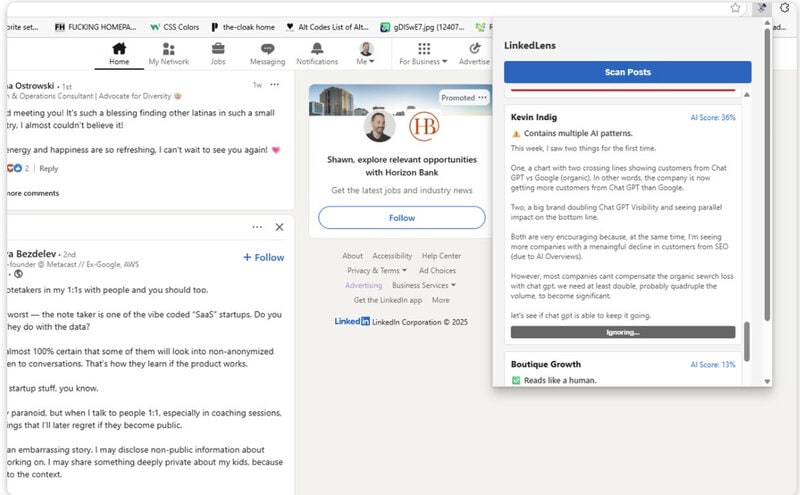
With more AI-generated posts appearing across LinkedIn, it can be difficult to tell when content has been written by a person or produced by an AI tool. LinkedLens is an open-source tool designed to detect likely AI-generated content in LinkedIn posts and comments. It uses a JavaScript-based algorithm that looks for patterns commonly associated with current-generation AI writing.
The tool is designed to give users a quick way to assess content without relying on a large third-party platform. As an open-source project, LinkedLens can also be explored and developed by others interested in AI detection. It offers a simple way to identify potential AI-generated “slop” while browsing LinkedIn. The tool runs locally, giving users a more private way to analyse content without sending their LinkedIn posts or comments to an external AI service.
Image Credit: LinkedLens
What Makes This Trend Stand Out
- Local AI Detection
- On-device content analysis creates opportunities for privacy-preserving tools that identify synthetic media without routing sensitive social data through centralized platforms.
- Open-source Trust Tools
- Community-developed verification software can disrupt proprietary credibility systems by making detection methods more transparent, adaptable, and auditable.
- Social Content Authenticity
- Rising volumes of AI-generated posts are reshaping demand for lightweight authenticity layers that help professionals assess credibility in real time.
Sectors Adopting This
- Professional Networking
- Platforms and companion tools for career-focused communities can differentiate through embedded signals that clarify whether posts and comments are human-written or machine-generated.
- Cybersecurity
- Detection of automated social content expands the security market beyond technical threats into reputation protection, influence monitoring, and synthetic communication risk.
- Enterprise Software
- Workplace productivity and collaboration vendors have room to integrate content-origin indicators that support internal trust, compliance, and knowledge-quality workflows.