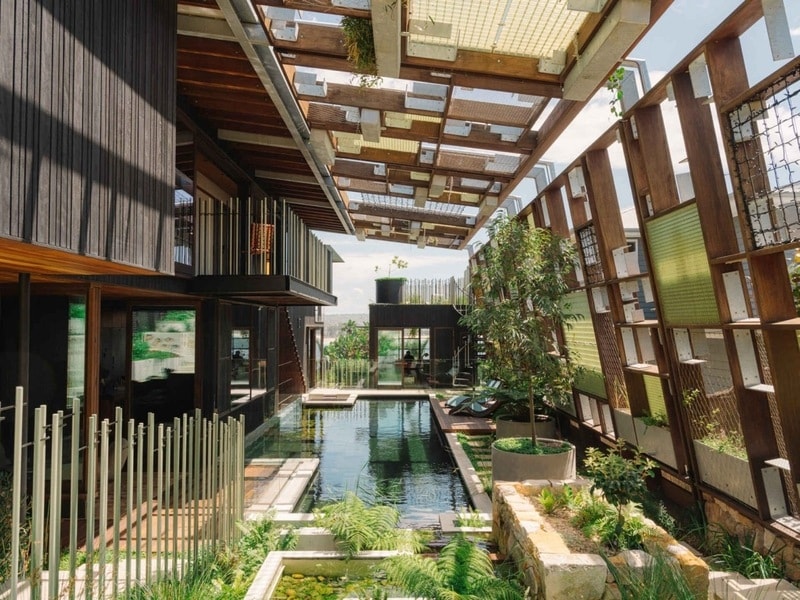
The Holocene House concept integrates water, plants, and architectural geometry is a residential architectural project by CplusC Architects and Builders that reimagines how indoor and outdoor environments intersect within a home. The design places a long, natural water channel as the organizing spine of the living space, with stepping stones leading through it and continual circulation of the water. Suspended above this central axis is a canopy formed by floating planters and geometric panels that create shifting light and microclimates across the interior, giving the structure a layered and dynamic spatial character.
The canopy system combines structural steel, timber beams, and translucent FRP panels to diffuse light and provide shading while supporting plant growth. Concrete planter boxes puncture the grid at varying heights, allowing foliage to drape and contribute to ambient cooling.
Image Credit: https://cplusc.com.au/
What Makes This Trend Stand Out
- Biophilic Interior Waterways
- Integrating moving water channels as central interior elements creates opportunities for residences to blend ecological systems with living spaces, enabling new service models around indoor water ecology and maintenance.
- Floating Canopy Microclimates
- Suspended planter grids and translucent panels produce layered light and humidity zones that could redefine zoned comfort strategies and personalized environmental controls within buildings.
- Structural Planter Integration
- Embedding concrete and timber planters into load-bearing grids suggests a convergence of landscape and structure that could spur multifunctional components combining greenery, thermal mass, and structural support.
Sectors Adopting This
- Residential Architecture
- Design practices focused on homes can be disrupted by hybrid indoor-outdoor typologies that prioritize ecological circulation and sculpted spatial sequences over conventional room-based planning.
- HVAC and Passive Cooling Systems
- Climate control firms may see their roles shift as plant-based shading, water evaporation, and canopy diffusion introduce low-energy microclimate techniques that complement or replace traditional mechanical systems.
- Building Materials and Prefab Components
- Manufacturers of translucent FRP panels, modular planter modules, and hybrid structural elements could capitalize on demand for offsite, integrated systems that streamline ecological-installation and reduce onsite complexity.