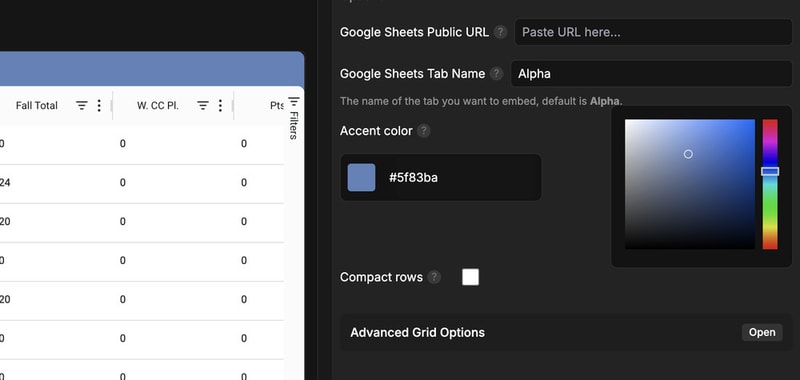
Google Sheet Embed positions itself within the no-code and lightweight web integration space, offering a way to transform spreadsheets into interactive website components. By enabling search, filtering, and sorting directly on embedded Google Sheets, it extends the functionality of a familiar productivity tool into a web-facing data layer.
From a business perspective, it appeals to startups, creators, and small teams seeking fast ways to publish and manage dynamic datasets without building custom backend systems. Its reliance on public Google Sheets simplifies data management but also introduces dependencies on sheet structure and access permissions. The value proposition centers on speed of deployment and flexibility, particularly for use cases like directories, dashboards, and listings. Its adoption will likely hinge on performance at scale and how well it balances customization with ease of implementation.
Image Credit: Google Sheet Embed
Key Themes Behind This Trend
- No-code Web Data Layers
- This approach enables non-developers to publish and update interactive data-driven web components rapidly, reducing reliance on custom backends and accelerating product iteration cycles.
- Embedded Live Spreadsheets
- By turning spreadsheets into live, searchable web tables, organizations can maintain a single source of truth that updates user-facing interfaces in real time without deployment overhead.
- Lightweight Frontend Data Tools
- The rise of minimal integration widgets shifts complexity to client-side filtering and rendering, enabling faster launch timelines while introducing novel scaling and performance considerations.
Where This Applies
- Small Business Saas
- Startups and small teams gain an affordable path to deliver dynamic listings and dashboards externally, altering how early-stage products validate market demand.
- Digital Publishing and Directories
- Publishers and directory operators can offer interactive, frequently updated content without full CMS integrations, changing expectations for content freshness and interactivity.
- Data Privacy and Compliance
- Dependency on public or shared spreadsheets raises new governance and access-control considerations for regulated sectors that must reconcile ease of use with stringent data protection requirements.