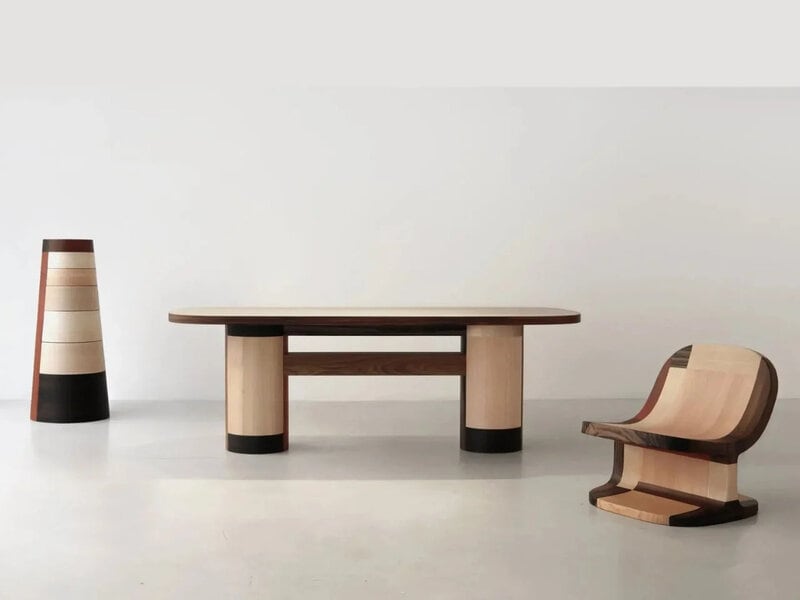
Studio Booboon has unveiled Fragments Becoming, a furniture collection crafted entirely from timber offcuts, demonstrating how discarded materials can become refined design objects. Comprising a cabinet, dining table, and lounge chair, the collection employs what the Copenhagen-based studio calls "3D marquetry," a construction method in which reclaimed wood fragments form both the structure and decorative pattern of each piece. Rather than applying ornament to a finished surface, the assembled timber creates a continuous visual composition throughout the furniture, while the use of unstained wood highlights the natural variation and character of every offcut.
Founded by Richard Bone and Jisu Yun, both former designers at Nendo, Studio Booboon combines contemporary furniture design with Korean craft traditions through materials including hanji paper, silk, canvas, and Ottchil lacquer. Premiered at Milan Design Week 2026 before appearing at Copenhagen's 3daysofdesign, Fragments Becoming presents sustainability as an integral design methodology rather than a finishing statement.
Image Credit: Studio Booboon
What's Driving This Trend
- Offcut-first Design
- Discarded production remnants are gaining value as primary inputs for premium goods, creating space for material-led collections that make waste visibly desirable.
- Structural Ornamentation
- Decorative surfaces are merging with core construction, enabling products where pattern, texture, and integrity are inseparable from the manufacturing process.
- Craft-tech Sustainability
- Traditional craft methods paired with contemporary fabrication are reframing sustainable design as a luxury language rather than a compromise.
Who This Affects Most
- Furniture Design
- High-end furniture brands can differentiate through reclaimed-material systems that deliver one-of-a-kind aesthetics alongside circular production models.
- Interior Architecture
- Commercial and residential interiors are suited to modular reclaimed-wood applications that turn material irregularity into a cohesive spatial identity.
- Sustainable Manufacturing
- Circular manufacturing platforms benefit from techniques that standardize the use of irregular offcuts while preserving their unique visual character.