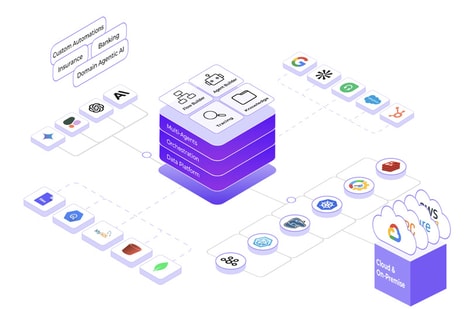
SAP is expanding enterprise AI with 'Joule Studio,' 'Joule Work,' and the 'SAP Business AI Platform,' which enable business users and developers to build agents that plan and execute work across SAP and third-party systems. The update adds no-code and pro-code authoring, access to more than 70 AI models, and 'n8n' workflow design for early adopters of Joule Studio.
'SAP Business Data Cloud' and 'SAP Knowledge Graph' tie those agents to a company's own records, while new controls track agent actions, model use, and spend. Select customers can run custom agents on SAP-managed Joule Studio runtime at no cost through December 2026. SAP also keeps customer data out of large language model training.
The free Joule Studio runtime through December 2026 lowers the risk of testing governed agents before a wider rollout. Use on the International Space Station provides a high-reliability proof point for SAP's table-focused model, shifting its AI pitch toward operational systems instead of chatbot experiments.
Image Credit: SAP
Key Themes Behind This Trend
- Governed Enterprise Agents
- Built-in controls for agent actions, model selection, and spend create openings for trusted automation across regulated operational workflows.
- No-code Agent Creation
- Business users gaining no-code tools for planning and execution signals a shift toward faster AI deployment beyond specialized developer teams.
- Operational AI Integration
- Connecting agents to enterprise records, knowledge graphs, and third-party systems positions AI as a core layer for business process execution.
Where This Applies
- Enterprise Software
- Platform vendors can differentiate by combining agent development, governance, workflow orchestration, and secure data connectivity in one environment.
- Business Process Automation
- Agentic workflows spanning SAP and external systems expand the market for automation tools that handle complex, multi-step enterprise tasks.
- Data Governance
- The need to monitor model use, protect customer data, and link AI to trusted records strengthens demand for governance infrastructure across AI ecosystems.