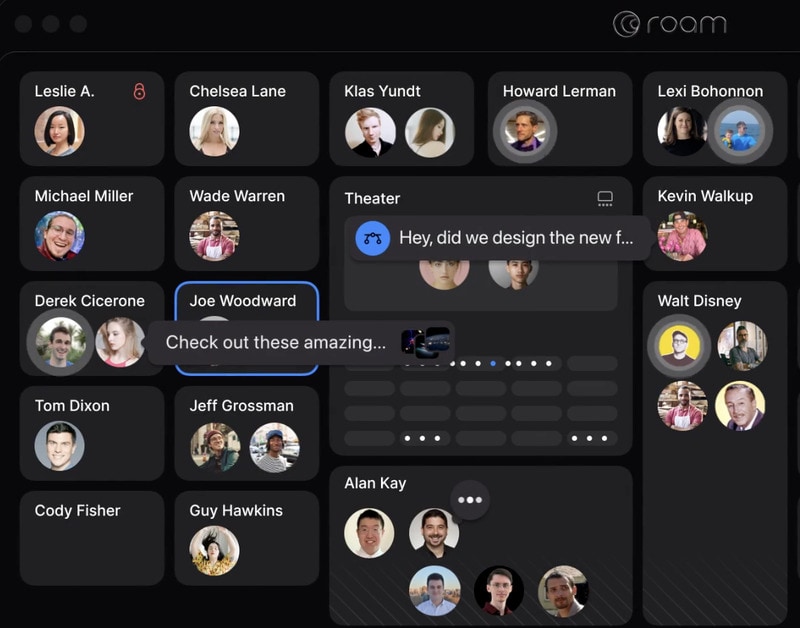
Roam is a digital work platform designed to support collaboration between people and AI within distributed organizations. Positioned as an “office of the future,” it combines multiple productivity tools into a single bundled environment intended to streamline workflows and reduce operational complexity.
The platform is built for globally distributed teams, reflecting the shift toward remote work and AI-assisted processes. From a business perspective, Roam addresses efficiency and cost management by consolidating tools and enabling AI to assist with routine and knowledge-based tasks. This integrated approach aims to improve coordination, accelerate output, and support scalable operations across time zones. By rethinking how teams collaborate in an AI-first environment, Roam represents an emerging category of workplace infrastructure focused on productivity, automation, and global workforce enablement.
Image Credit: Roam
Why This Trend Is Growing
- AI-augmented Collaboration
- AI-Augmented Collaboration enables seamless blending of human judgment and machine assistance, creating environments where complex decision-making and routine execution are co-managed within a single workflow.
- Unified Productivity Ecosystems
- Unified Productivity Ecosystems consolidate disparate tools into integrated platforms that markedly reduce operational overhead and improve cross-functional visibility for distributed teams.
- Distributed Team Automation
- Distributed Team Automation brings time-zone-aware orchestration and AI-driven task delegation that can scale knowledge work across global workforces without linear headcount increases.
Industries Being Reshaped
- Enterprise Software
- Enterprise Software stands to be reshaped by platforms that bundle collaboration, knowledge management, and AI assistants into single subscriptions, shifting buyer preference from point solutions to integrated suites.
- Human Resources and Talent Management
- Human Resources And Talent Management can be transformed by AI-enabled systems that surface skills, automate enablement pathways, and match distributed talent to project needs with greater precision.
- Remote Work Infrastructure
- Remote Work Infrastructure is positioned for disruption as integrated AI-driven platforms reduce dependency on multiple third-party services and create new standards for synchronous and asynchronous collaboration.