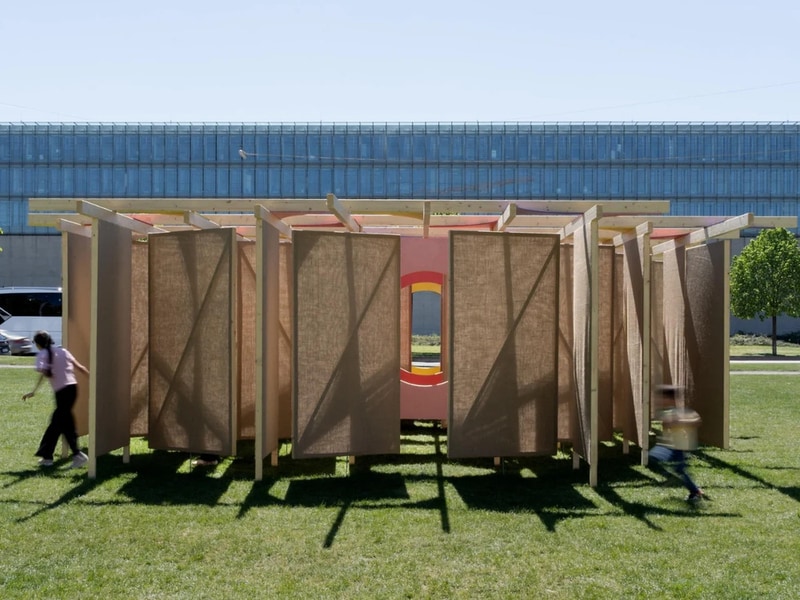
DELULU by Studio Carraldo is an interactive labyrinth installation created for Munich Creative Business Week 2026. The project takes its name from the Gen Z slang term “delulu,” derived from “delusional,” which describes retreating into fantasy or wishful thinking when reality becomes overwhelming. The installation translates that idea into a physical environment made from movable partitions that continuously alter pathways and circulation routes.
The structure is composed of jute fabric walls suspended from an overhead framework and guided along floor tracks, allowing visitors to manually reposition sections of the maze. As pathways shift, the installation changes between enclosed and open conditions, creating moments of disorientation, isolation, and encounter. The material system relies on low-tech construction methods, using lightweight fabric surfaces and simple mechanical movement rather than digital interaction systems. The project references philosopher Timothy Morton’s concept of “hyperobjects,” using unstable spatial conditions to reflect themes of climate anxiety, digital overload, and social uncertainty.
Image Credit: Studio Carraldo
What Makes This Trend Stand Out
- Mutable Physical Interfaces
- Spatial systems that allow visitors to reconfigure partitions and pathways point to novel modular architecture models where adaptability is embedded in everyday interiors.
- Low-tech Interactive Design
- Simple mechanical movement and fabric materials demonstrate potential for scalable, low-cost immersive experiences that bypass digital complexity.
- Affective Spatial Narratives
- Environments that evoke disorientation and encounter reveal opportunities for spaces that externalize emotional states as core content rather than mere backdrop.
Sectors Adopting This
- Exhibition and Events
- Immersive festivals and trade shows could be transformed by dynamically reconfigurable installations that change visitor flow and storytelling in real time.
- Therapeutic and Wellness Design
- Clinical and wellness settings informed by mutable labyrinthine layouts suggest new modalities for processing anxiety and guiding reflective experiences through architecture.
- Retail Environments
- Shoppable spaces employing shifting partitions and curated disorientation indicate possibilities for experiential merchandising that reshapes consumer attention and dwell time.