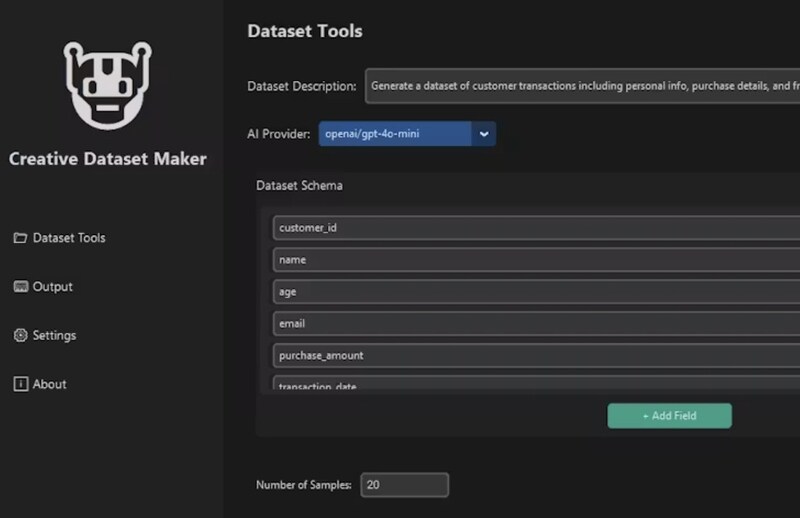
Building datasets for machine learning, research, and testing can be a time-consuming process that often requires significant manual effort -- Creative Dataset Maker is a tool which is designed to streamline this workflow through AI-assisted dataset generation.
The platform generates structured datasets based on user-defined requirements, helping teams create data for experimentation, prototyping, model development, and other analytical tasks. Its automation-focused approach reduces the need to manually compile large volumes of information.
Creative Dataset Maker is aimed at developers, data scientists, researchers, and AI practitioners who need datasets for testing, analysis, or model development. Its focus on automated data generation makes it a useful resource for projects where collecting or creating data manually would be impractical or time-intensive.
Image Credit: Creative Dataset Maker
What's Driving This Trend
- Synthetic Dataset Automation
- AI-generated datasets are reducing manual data preparation burdens while creating room for faster experimentation, lower prototyping costs, and more accessible model development workflows.
- No-code Data Creation
- User-defined dataset tools are expanding data generation beyond technical specialists, enabling broader participation in analytics, research, and machine learning validation.
- Rapid AI Prototyping
- Automated data creation is compressing development timelines for AI projects, allowing teams to test concepts and refine models before real-world data is available.
Who This Affects Most
- Artificial Intelligence
- Machine learning teams benefit from scalable synthetic data sources that support model testing, benchmarking, and iteration in environments where authentic data is limited.
- Data Analytics
- Analytics platforms gain value from on-demand structured datasets that improve simulation, reporting, and exploratory analysis without relying on lengthy collection processes.
- Research Technology
- Academic and commercial researchers can use AI-assisted dataset generation to support controlled experiments, replicate scenarios, and reduce dependence on manual data assembly.