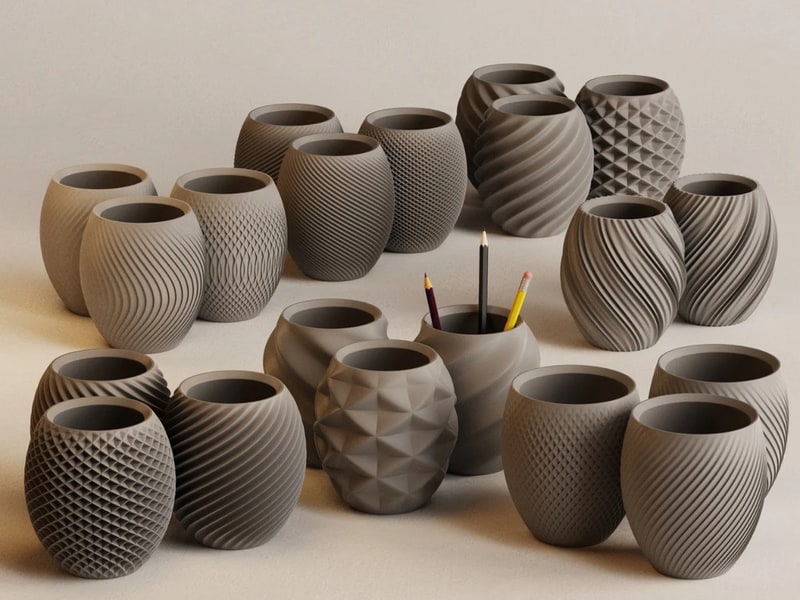
The Aya & Sfera collection by Ikigaiform is a series of 3D-printed cups adapted from larger self-watering planter designs. The objects retain the same geometries as the original planters, resized into compact formats suited for desks and shelves. Each piece is produced using parametric modeling, resulting in intricate surface patterns that respond to light and viewing angle. The collection is designed as functional storage for items such as pens, toothbrushes, and small tools.
Two distinct series define the range. Aya uses spiral forms derived from vine growth structures, creating a sense of continuous rotation across the surface. Sfera introduces rounded profiles with wave and pinecone-like textures, alongside a newer S-curve pattern. Files are distributed in STL and 3MF formats with preconfigured print settings, allowing production on standard FDM printers without supports. Each unit measures roughly 100 by 110 millimetres and can be printed individually or in grouped sets.
Image Credit: Ikigaiform
Why This Trend Is Growing
- Parametric Miniaturization
- Compact, algorithmically generated designs enable high-detail, small-footprint objects that blur the line between decor and functional storage.
- Desktop Distributed Fabrication
- Preconfigured STL and 3MF files for common FDM printers support local, on-demand production of personalized deskware and small-batch runs.
- Surface-responsive Aesthetics
- Geometry-driven surface patterns that shift with light and viewing angle introduce tactile branding and product differentiation without additional materials.
Industries Being Reshaped
- Office Supplies and Organizational Products
- Custom-printable organizers create potential for tailored modular systems that can supplant mass-produced plastic stationery holders.
- Additive Manufacturing Services
- Service bureaus may scale parametric design libraries to offer on-demand, low-volume production of designer desktop items for retailers and businesses.
- Home Decor and Lifestyle Goods
- Small-scale 3D-printed pieces with intricate, algorithmic geometries form a niche between handcrafted ceramics and mass-market décor offerings.