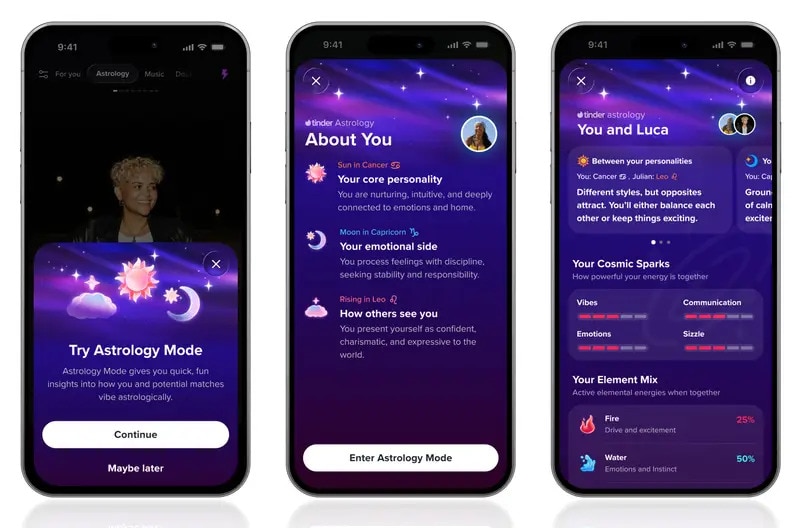
Tinder Astrology Mode was announced at Tinder's inaugural product keynote, Tinder Sparks 2026: Start Something New, alongside other modes designed to turn matches into real conversations. Astrology Mode on Tinder provides an opportunity for app users to "match based on what the stars have to say," letting their birth details, sun, moon and rising placements provide insights into how they might get along with a potential match. Already, early testing showed a nearly 20% increase in Likes sent by women on Astrology profiles.
For those drawn to it, astrology offers a framework for self-understanding that feels personal and expansive at once, and for Gen Z in particular, the shaped language of sun signs offers a fun way to spark conversation, connect with shared traits, and understand contrasts in personality.
What Makes This Trend Stand Out
- Personalized Matchmaking Via Birth Data
- Integration of natal chart elements into matching algorithms reveals potential for hyper-personalized compatibility scoring that shifts recommendation criteria from behavior to declared identity attributes.
- Astrology-driven Social Language
- A shared zodiac lexicon appears to function as a lightweight cultural protocol for initiating conversations and signaling personality, enabling platforms to surface affinity cues beyond traditional interests.
- Gamified Identity Signals
- Presenting birth placements as collectible or tiered profile elements creates mechanisms for playful status signaling and engagement loops that reframe profile completeness around expressive identity tokens.
Sectors Adopting This
- Online Dating Platforms
- Dating services could be disrupted by embedding esoteric identity dimensions into core UX, transforming match discovery and retention through culturally resonant personalization layers.
- Social Media and Messaging
- Messaging apps and social networks stand to capitalize on lightweight affinity markers like sun, moon and rising signs as contextual metadata that enrich conversation prompts and community formation.
- Identity Verification and Data Services
- Companies handling personal data may find new product lines in curating, validating and privately storing birth-detail datasets that support niche personalization while raising novel privacy design requirements.