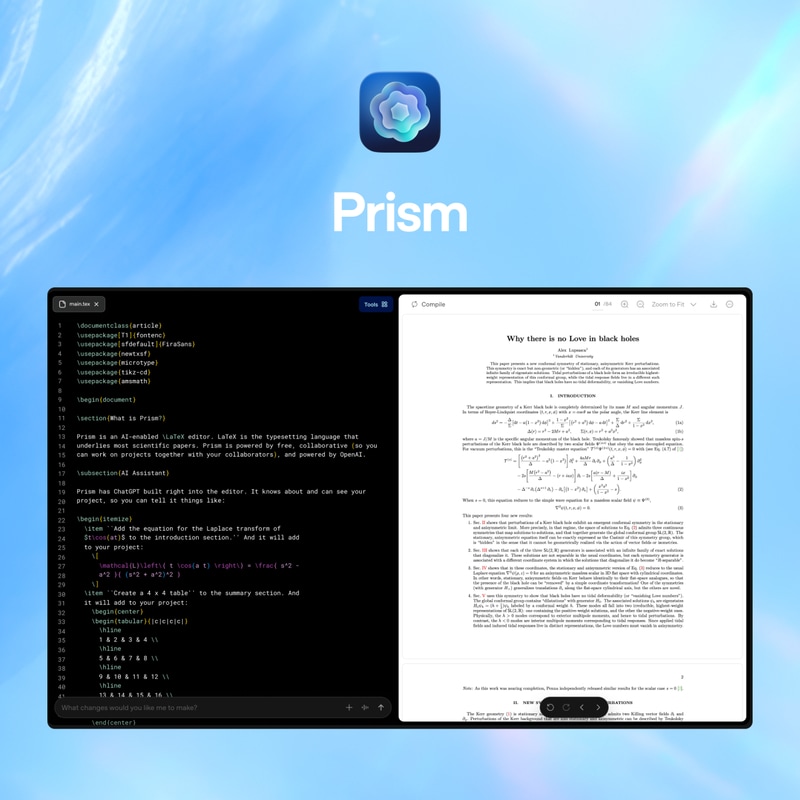
OpenAI's Prism is a free web-based workspace that embeds AI into the writing and organization of scientific papers. Available to anyone with a ChatGPT account, the platform combines word processing with research assistance, positioning itself as an everyday tool for working scientists. Its key distinction is deep integration with OpenAI’s GPT-5.2 model, which supports claim checking, language refinement, and literature exploration directly inside a structured authoring environment.
Prism builds on existing academic workflows rather than replacing them, with native support for LaTeX formatting, the long-standing standard for scientific typesetting. The software also leverages GPT-5.2’s multimodal capabilities, enabling users to convert digital whiteboard sketches into polished diagrams for inclusion in manuscripts. A dedicated ChatGPT panel provides full access to a project’s context, enabling responses that reflect the entire paper rather than isolated prompts.
For researchers, Prism streamlines tedious aspects of scientific writing and documentation while keeping humans in control of the underlying work. By aligning AI support with familiar tools and formats, it lowers barriers for scientists who already use LaTeX or ChatGPT but lack an integrated workspace. The launch underscores a broader shift toward workflow-level AI in knowledge professions, mirroring how AI code assistants reshaped software development by embedding intelligence directly into everyday interfaces.
Image Credit: OpenAI
Why This Trend Is Growing
- AI-driven Scientific Publishing
- AI integration into scientific publishing is transforming traditional writing and research processes, enabling more efficient and refined academic output.
- Multimodal AI Capabilities
- The use of AI's multimodal features allows for seamless integration of various media types into research documents, enhancing the visual component of scientific communication.
- Workflow-level AI Integration
- AI-enhanced tools embedded within everyday workflows are revolutionizing knowledge professions, mirroring innovations seen in software development.
Industries Being Reshaped
- Academic Research
- Innovative AI-powered platforms are reshaping the landscape of academic research, offering tools that streamline complex writing and documentation tasks.
- Scientific Publishing
- The scientific publishing industry stands to benefit from AI tools that enhance content creation and offer refined language and structural integrity in manuscripts.
- Educational Technology
- EdTech solutions are being transformed by advanced AI capabilities, providing academics with interactive and supportive research environments.