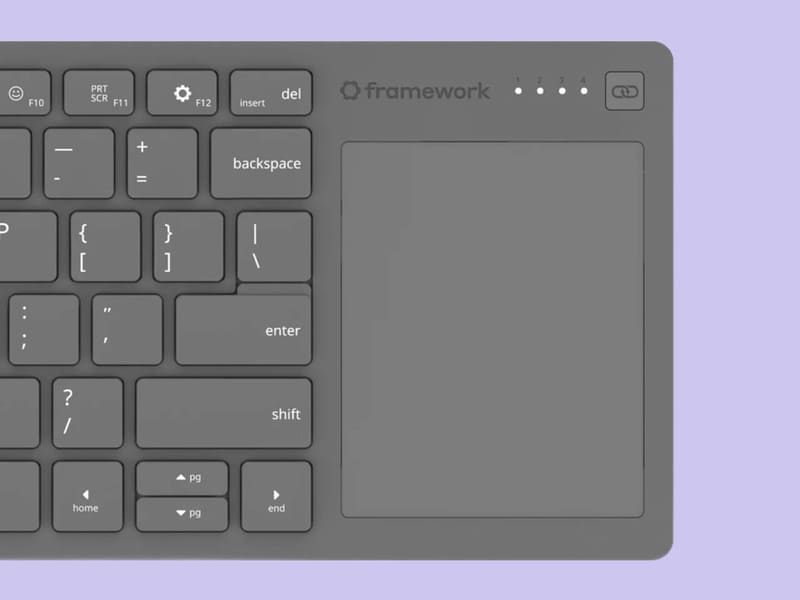
The Framework Wireless Touchpad Keyboard is designed to replace the long-dominant but widely criticized couch keyboard format, rethinking how users interact with a PC from a distance. Built using the same components as Framework’s laptops, it adopts chiclet-style keys with 1.5mm travel and full 19mm spacing, delivering a more consistent typing experience than typical living room keyboards. The compact form is designed to be used one-handed while seated, without sacrificing key feel or layout quality.
A major upgrade comes from the integrated Windows Precision touchpad, measuring 68.8 by 85.6mm and supporting full multi-touch gestures across Windows and Linux systems. Connectivity includes Bluetooth pairing for up to four devices, USB-C wired use, and a USB-A dongle that stores directly in the keyboard. The hardware is also open-source, with CAD files and a customizable control board available.
Image Credit: Framework
Why This Trend Is Growing
- Living-room Ergonomic Keyboards
- A shift toward one-handed, laptop-grade typing in shared spaces that challenges bulky remote-style controllers and redefines comfort expectations for casual PC use.
- Open-source Hardware Peripherals
- Community-accessible CAD files and customizable control boards enabling rapid iteration and niche specialization outside traditional OEM constraints.
- Multi-device Seamless Input
- Unified Bluetooth pairing and integrated dongle storage that blur lines between desktop, laptop, and media device input ecosystems for frictionless switching.
Industries Being Reshaped
- Consumer Electronics
- Premium compact keyboards with precision touchpads present opportunities to disrupt the accessory market by combining laptop-quality input with living-room convenience.
- Home Entertainment
- Enhanced typing and gesture control from the couch introduces new interaction models for streaming platforms and smart TV ecosystems that move beyond simple remote navigation.
- Accessibility and Assistive Tech
- High-quality one-handed layouts and customizable firmware arrangements can enable tailored input solutions for users with mobility limitations or specialized needs.