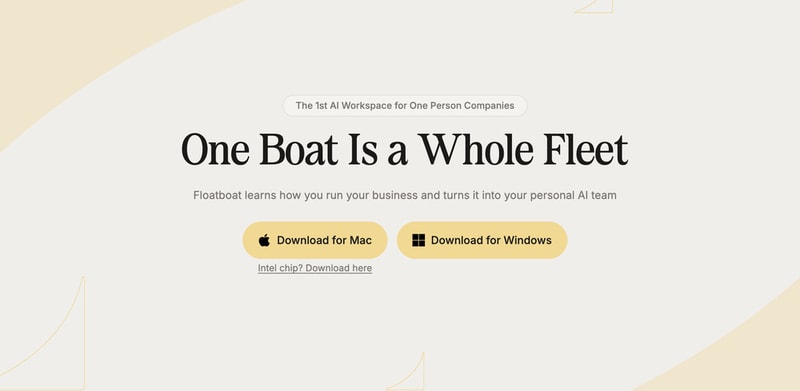
As businesses increasingly adopt artificial intelligence tools, a new category of productivity platforms is emerging—AI-powered workflow agents that can automate complex digital tasks without requiring extensive technical setup.
FloatBoat AI represents this growing shift toward autonomous work management. The platform enables users to create intelligent agents that can handle repetitive processes, coordinate tasks across multiple tools, and execute workflows automatically. Rather than relying on traditional manual task management or isolated automation scripts, these AI agents function as adaptive digital assistants capable of managing ongoing operational workflows.
The concept reflects a broader industry trend where AI is moving beyond simple chat interfaces into systems that can actively perform work. From coordinating data flows to managing routine operational tasks, AI workflow agents are becoming an increasingly practical solution for teams looking to reduce manual processes and improve efficiency.
As organizations continue to explore AI-driven productivity tools, platforms like FloatBoat AI highlight how automation is evolving from single-task scripts into fully autonomous workflow management systems.
Key Themes Behind This Trend
- Autonomous Workflow Agents
- Organizations are able to offload end-to-end operational processes to adaptive agents that reduce reliance on human oversight and scripted automations.
- Cross-tool Coordination
- Integrated agents that mediate data and task flows across multiple SaaS platforms enable seamless orchestration of complex, multi-application workflows.
- No-code AI Orchestration
- Low-technical-entry platforms are making it possible for non-engineering teams to compose, customize, and deploy autonomous workflows without writing code.
Where This Applies
- Enterprise Software
- Workflow-centric AI agents present opportunities to embed autonomous orchestration directly into CRM, ERP, and collaboration suites to streamline enterprise operations.
- Healthcare Operations
- Automated agents offer potential to coordinate administrative tasks, patient scheduling, and interdepartmental data handoffs while maintaining compliance constraints.
- Financial Services
- AI workflow agents could centralize transaction monitoring, report generation, and regulatory reconciliation across disparate banking and trading systems.