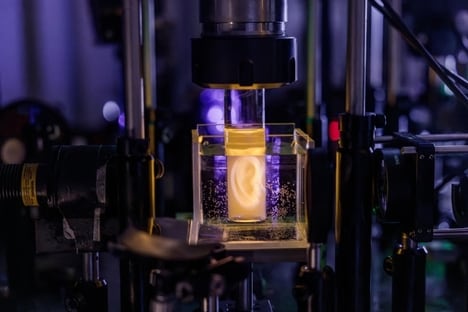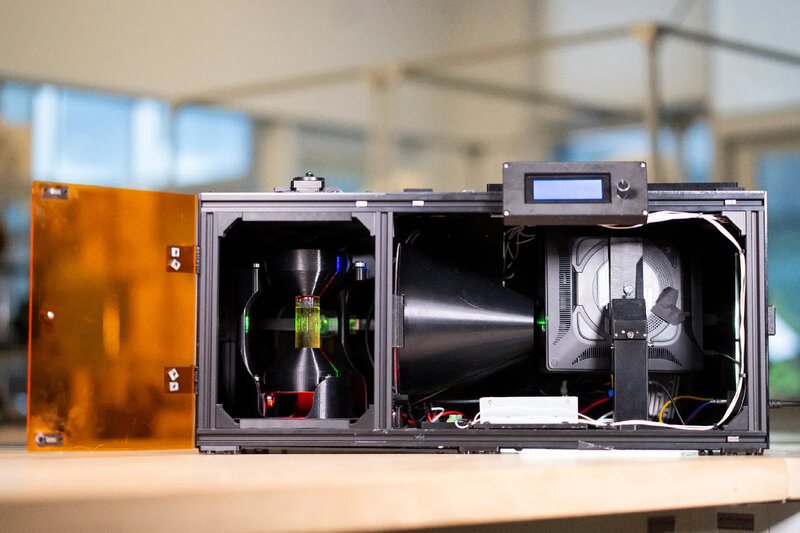
UC Berkeley, in collaboration with Prusa Research and Formlabs, is opening computed axial lithography to university labs and home users with ‘OpenCAL,’ a build-it-yourself volumetric 3D printer that forms parts all at once rather than stacking layers. The process spins a resin vial under projected light, giving users a layer-free way to create shapes using technology that typically remains in research labs.
Using a standard projector, ‘OpenCAL’ printed a replica of Rodin’s ‘The Thinker’ in 90 seconds without support structures. Formlabs makes the resin sold through Prusa Research, while the project’s CAD files and source code are publicly available.
A roughly $1,600 parts cost makes volumetric printing a realistic co-creation project for campus labs and home builders rather than a closed specialty machine. Public files and ready-made resin widen access to a fast process that also extends to optics and bioprinting work.
Image Credit: OpenCAL / UC Berkeley
Key Themes Behind This Trend
- Open-source Fabrication
- Public CAD files and shared source code create pathways for lower-cost hardware ecosystems that let researchers, makers, and small firms experiment beyond proprietary manufacturing platforms.
- Volumetric 3D Printing
- Layer-free object creation introduces faster prototyping possibilities for complex geometries, delicate structures, and support-free forms that conventional additive manufacturing struggles to produce efficiently.
- Desktop Lab Equipment
- Affordable build-it-yourself research tools blur the line between institutional labs and home workspaces, expanding access to advanced experimentation in optics, materials, and bioprinting.
Where This Applies
- Additive Manufacturing
- Whole-object printing can reshape rapid prototyping and short-run production by reducing print times, support material needs, and design constraints tied to layer-based systems.
- Biotechnology
- Accessible volumetric printing platforms provide new potential for tissue-like structures and biofabrication research outside highly specialized facilities.
- Education Technology
- University labs and maker programs gain hands-on access to advanced fabrication systems that support interdisciplinary learning across engineering, design, and life sciences.