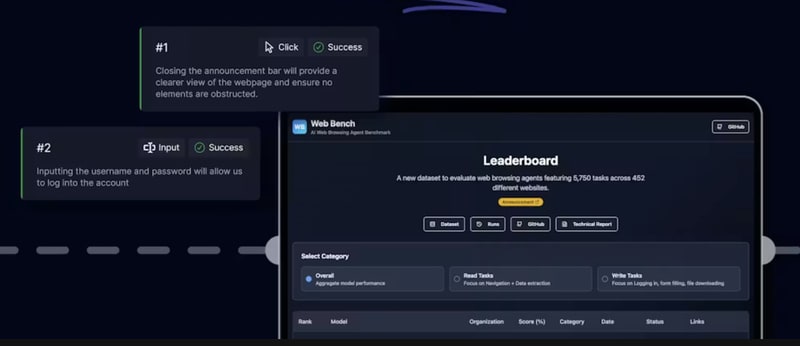
As AI browser agents become more capable, it’s increasingly difficult to compare them using meaningful, real-world metrics -- Web Bench solves this by providing a dedicated benchmark for evaluating how effectively AI agents navigate and interact with the web.
The platform tests and compares different browsing agents across a range of web-based tasks, offering detailed performance metrics beyond simple model comparisons. This helps users understand how agents perform in practical environments rather than isolated benchmarks. Teams can use standardized evaluations to assess strengths, weaknesses, and reliability. This makes agent selection and development more data-driven.
Web Bench is aimed at AI developers, researchers, and organizations building autonomous agents. By benchmarking real-world browsing performance, it helps bring greater transparency and rigor to AI agent evaluation.
Image Credit: Web Bench
Key Themes Behind This Trend
- Real-world Agent Benchmarking
- Benchmarking AI agents on live web tasks exposes practical capability gaps that can redefine agent architecture priorities and user trust models.
- Transparent Performance Metrics
- Providing granular, interpretable metrics for browsing behaviors creates new avenues for differentiated product positioning and accountability frameworks.
- Standardized Agent Evaluation
- A common evaluation suite enables cross-vendor comparability that could shift market dynamics toward certification-driven adoption.
Where This Applies
- Autonomous Software Agents
- Agent developers gain the ability to benchmark navigation reliability and task completion fidelity, influencing design trade-offs between autonomy and safety.
- Enterprise It Procurement
- Procurement teams can base vendor selection on empirical web-performance scores, changing contracting criteria and total-cost-of-ownership calculations.
- AI Research and Development
- Researchers receive standardized real-world evaluation data that can uncover new research directions in robustness, generalization, and human-agent interaction.