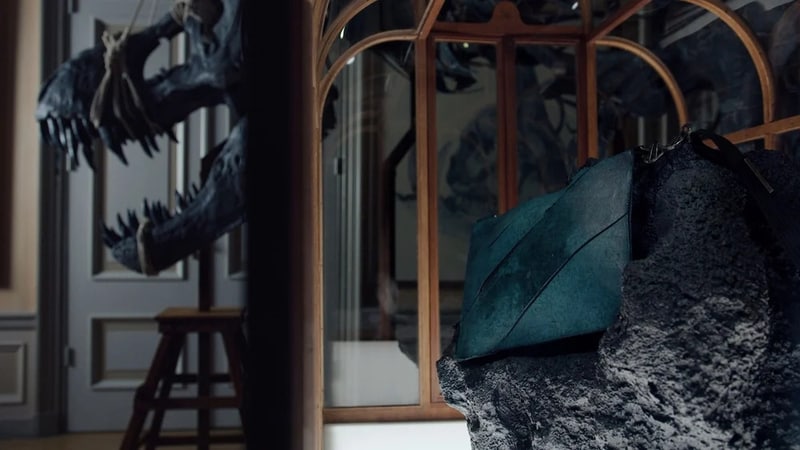
The T-Rex leather handbag is an accessory made from lab-grown collagen based on Tyrannosaurus rex protein sequences. The material was developed by VML, The Organoid Company, and Lab-Grown Leather Ltd. using reconstructed DNA data and biofabrication methods. The handbag was designed by Enfin Levé, the studio founded by Michał Hadaś, as a physical application of the material in a finished product.
The material is grown through a scaffold-free process where collagen forms its own structure during cultivation. The resulting surface has a dense, fibrous composition similar to traditional leather and can be cut, shaped, and finished using standard leatherworking techniques. The bag features a structured silhouette with reinforced edges and a smooth exterior finish that highlights the material’s uniform texture.
The handbag was produced as a single piece and presented at the Art Zoo Museum in Amsterdam. The project introduces a fabricated leather derived from extinct species data and applies it to a functional object through established garment and accessory construction methods.
Image Credit: VML
What's Driving This Trend
- Extinct-genomics Materials
- A new class of materials reconstructed from extinct species' DNA that opens unconventional provenance narratives and collectible value propositions for design-led products.
- Scaffold-free Biofabrication
- Signals a shift toward self-organizing collagen cultivation methods that yield leather-like surfaces compatible with traditional cutting and finishing workflows.
- Lab-grown Luxury Goods
- Positions biologically produced materials as status-driven luxury components that blend scientific novelty with established craftsmanship aesthetics.
Who This Affects Most
- Luxury Fashion
- The fashion sector faces opportunities from biologically engineered leathers that introduce new storytelling, rarity, and material differentiation for high-end accessories.
- Biomaterials Manufacturing
- Manufacturers of sustainable materials could be disrupted by scaffold-free collagen production techniques that alter supply chains and material scalability assumptions.
- Museum and Cultural Institutions
- Curatorial practices and exhibition economies may be transformed by objects that merge extinct-genome science with design, creating cross-disciplinary programming and audience interest.