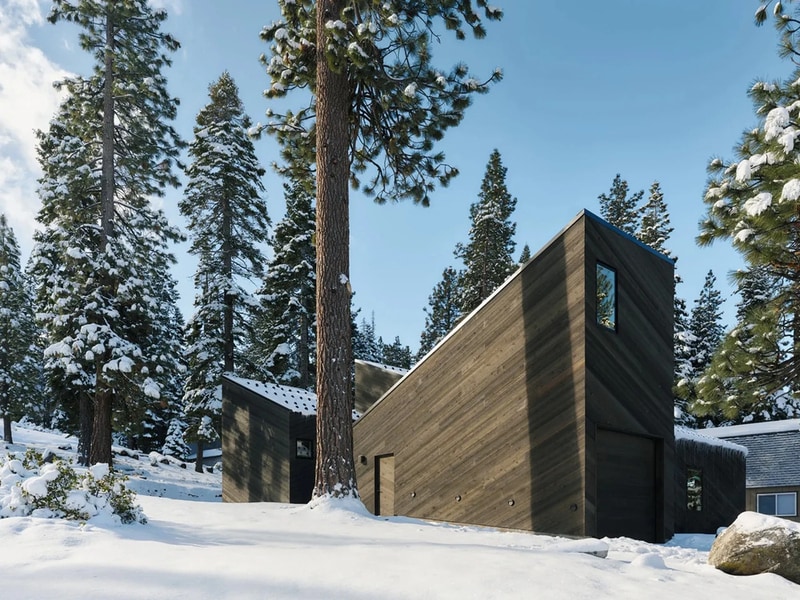
The Staggered Cabin by Mork-Ulnes Architects is a compact alpine residence in South Lake Tahoe composed of four offset volumes that step down the natural incline of the site. Rather than flattening the terrain, the design distributes the structure across the slope, allowing existing granite boulders and pine trees to remain largely undisturbed. Each cedar-clad volume is positioned to create a sequence of outdoor spaces between them, forming courtyards that extend the interior into the landscape.
The sectional layout organizes living spaces vertically across the staggered forms, with each volume responding to light, views, and elevation. This arrangement produces varied spatial conditions, from more enclosed areas to open, light-filled zones connected to the forest. The dark cedar exterior minimizes visual impact while reinforcing durability in the alpine climate.
Image Credit: Mork-Ulnes Architects
What's Driving This Trend
- Slope-integrated Architecture
- A design approach that follows natural inclines enables buildings to occupy uneven sites with reduced earthwork and site disturbance, creating potential for specialized construction systems tailored to topography.
- Fragmented Volume Courtyards
- Sequenced offset volumes that produce interstitial outdoor rooms generate varied spatial conditions and private exterior spaces, offering new models for adaptable indoor-outdoor programming.
- Low-impact Material Palettes
- Use of dark cedar and other context-sensitive claddings minimizes visual intrusion and increases durability in alpine climates, suggesting demand for materials that balance aesthetics with environmental resilience.
Who This Affects Most
- Prefabricated Modular Construction
- Modular units designed to be arranged in staggered configurations could simplify assembly on steep sites and enable repeatable systems for complex terrain.
- Landscape-conscious Real Estate Development
- Developments that prioritize existing rock and tree retention can enhance experiential value and differentiate properties through integrated nature-first design strategies.
- Alpine-resilient Building Materials
- Materials engineered for freeze-thaw cycles, UV exposure, and moisture management address performance gaps in mountain architecture and enable longer-lasting, low-maintenance exteriors.