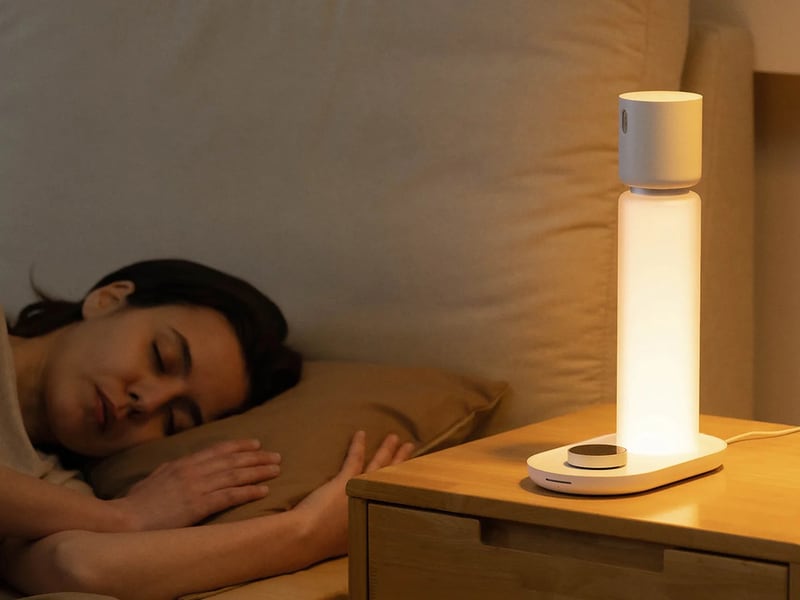
The Sleepal lamp by Ningning Li, Haorong Liu, and Jiantao Sha integrates sleep tracking into a bedside light, replacing wearable devices with a passive, contactless system. Instead of requiring a watch or ring, the lamp uses built-in 60 GHz millimeter-wave radar to detect breathing and heartbeat micro-movements during sleep. This allows the device to monitor sleep stages without physical contact, removing the need to wear or adjust anything before bed.
The lamp also functions as an environmental and behavioral tool, adapting light output to support circadian rhythms by dimming at night and gradually brightening in the morning. It collects environmental data alongside biometric signals, combining them into a sleep report generated through an AI model trained on large clinical datasets. Setup is minimal, requiring only initial pairing, after which the system runs automatically each night.
Image Credit: Ningning Li, Haorong Liu, Jiantao Sha
What Makes This Trend Stand Out
- Contactless Sleep Monitoring
- The shift from wearables to radar-based bedside devices opens possibilities for widespread, unobtrusive biometric collection that can scale across nonclinical settings.
- Integrated Environmental-biometric Devices
- Combining ambient light control with real-time physiological sensing creates systems that can personalize sleep environments based on both behavior and room conditions.
- AI-driven Passive Health Monitoring
- Training models on large clinical datasets to interpret passive signals offers routes to continuous, low-friction health insights that could supplant episodic diagnostics.
Sectors Adopting This
- Consumer Sleep Tech
- Products that eliminate wearables in favor of contactless bedside units could redefine user adoption curves and create new service ecosystems around sleep analytics.
- Smart Home Lighting
- Lighting manufacturers integrating sensing and AI could shift value from bulbs to data platforms that optimize circadian health across the home.
- Health Insurance and Remote Care
- Insurers and telehealth providers gaining access to passive sleep and environmental data may be able to underwrite risk and manage chronic conditions with finer-grained monitoring.