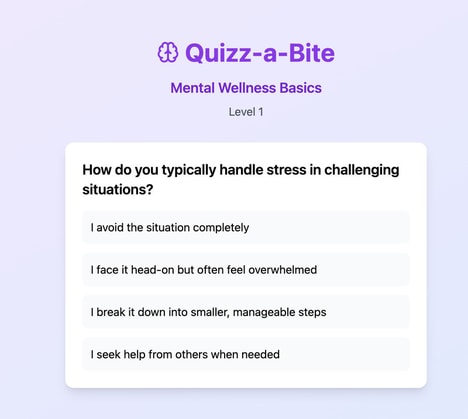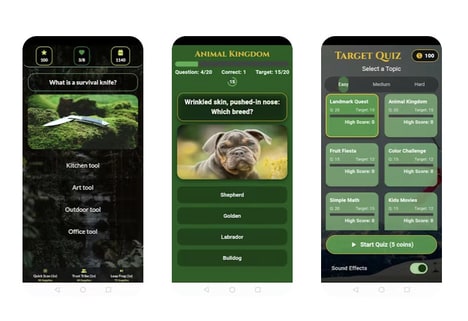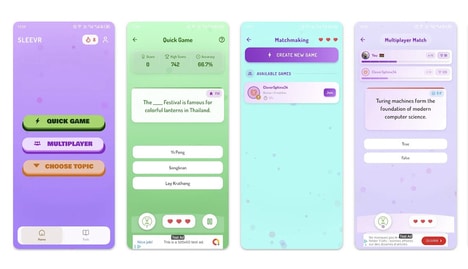
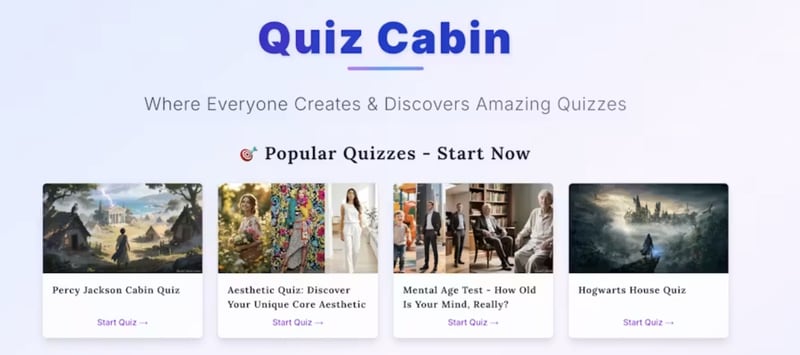
People often want to test their knowledge or explore personality insights, but most quiz platforms feel repetitive or limited in scope. Quiz Cabin solves this by offering a space where users can both create and discover engaging quizzes.
The platform features personality tests, trivia challenges, and brain games designed to be both entertaining and thought-provoking. This makes it easy for users to learn something new while staying engaged. Users can actively participate or build their own quizzes, turning curiosity into interactive experiences. This creates a cycle of discovery and creation within the same platform.
Quiz Cabin is aimed at casual learners and entertainment seekers. By combining quiz creation with discovery, it makes learning and self-exploration more playful and social.
Image Credit: Quiz Cabin
Why This Trend Is Growing
- User Generated Gamified Learning
- Platforms enabling users to create and share bite-sized games are reshaping how informal learning content is produced and consumed, allowing rapid diversification of topical micro-courses.
- Micro Personality Profiling
- A rise in short, shareable personality diagnostics is enabling fine-grained self-insight slices that can be combined to form dynamic user profiles for personalized experiences.
- Social Discovery Feedback Loops
- The integration of discovery with creation is producing continuous engagement cycles where community reactions drive iterative content evolution and trend formation.
Industries Being Reshaped
- Educational Technology
- Adaptive quiz and challenge formats are creating opportunities for more engaging assessment tools that measure learning through play and behavioral signals rather than traditional tests.
- Social Networking
- Casual, shareable quiz experiences are transforming social feeds into interactive touchpoints that amplify virality and deepen peer-to-peer engagement metrics.
- Casual Gaming
- Simple, creator-driven brain games are blurring lines between entertainment and cognitive training, enabling new monetization models around modular game content and microtransactions.