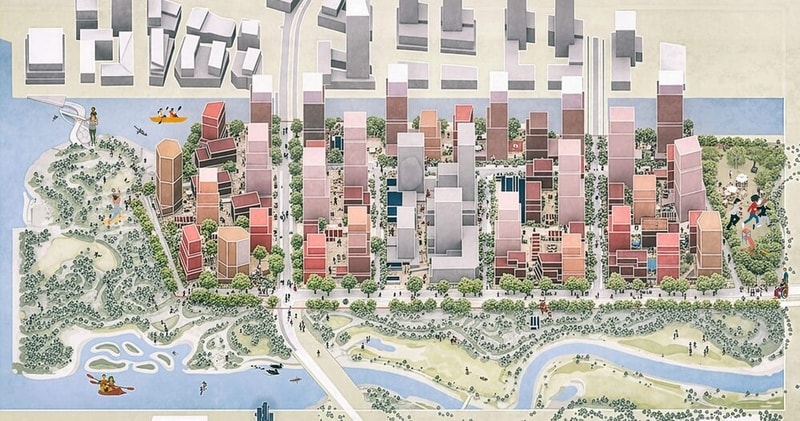
The Port Lands proposal by SLA outlines a car-free waterfront neighborhood planned for the Port Lands area in Toronto. The masterplan includes pedestrian-focused streets, cycling infrastructure, mixed-use residential buildings, wetlands, public plazas, and landscaped pathways integrated throughout the district. Large sections of the neighborhood are designed without conventional vehicle traffic, with transportation centered around walking, cycling, and transit access instead.
The proposal features timber residential buildings arranged alongside green corridors and publicly accessible waterfront areas extending across the redevelopment site. Elevated walkways, planted public spaces, and ecological restoration areas are incorporated throughout the plan alongside new housing and commercial zones. SLA developed the proposal with local architecture and planning teams as part of a broader long-term transformation of Toronto’s former industrial waterfront lands into a dense mixed-use district centered on public access and climate-focused urban planning.
Image Credit: SLA
What's Driving This Trend
- Car-free Urban Districts
- A shift toward neighborhoods designed without private vehicles creates potential for reimagined last-mile logistics, delivery systems, and service models optimized for pedestrian-priority streets.
- Green-integrated Housing
- Timber residential buildings paired with continuous green corridors open avenues for sustainable materials innovation, biophilic design integrations, and performance-based façade systems.
- Active Mobility Infrastructure
- Extensive cycling networks, elevated walkways, and transit-focused access enable new product and service ecosystems around micro-mobility fleets, parking-free property models, and infrastructure-as-a-service.
Who This Affects Most
- Urban Planning and Development
- Masterplans emphasizing public plazas, ecological restoration, and mixed-use density present opportunities for data-driven placemaking, climate-resilient zoning approaches, and value-capture financing innovations.
- Construction and Timber Building
- The prominence of timber construction alongside landscape-integrated builds suggests room for prefabricated mass-timber systems, circular-material supply chains, and low-carbon construction methods.
- Public Transit and Micro-mobility
- A transit-centered neighborhood model supports development of integrated ticketing, shared-mobility networks, and curbspace management platforms tailored to vehicle-free corridors.