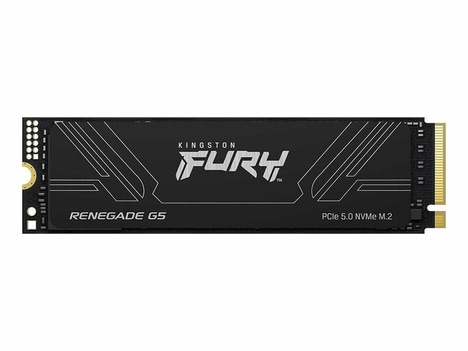
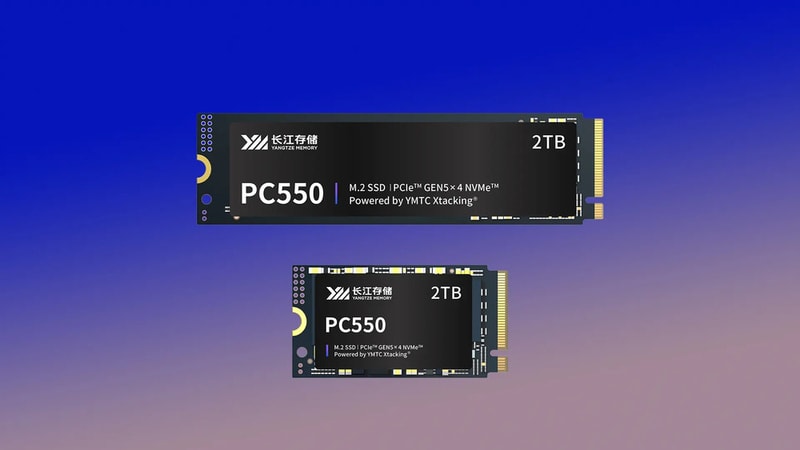
Chinese flash manufacturer Yangtze Memory Technologies Co. (YMTC) introduced its first commercial PCIe 5.0 drive, the PC550, featuring the company’s Xtacking 4.0 NAND architecture designed to boost throughput for AI PCs and commercial servers. The launch positioned YMTC as a contender in next-gen storage by pairing PCIe 5.0 interface speeds with its internally developed 3D NAND methods.
The PC550’s specifications highlighted higher sequential read/write rates and improved IOPS suited for data‑intensive workloads, and YMTC emphasized compatibility targets across desktop and enterprise markets. For consumers and businesses, the PC550 matters because it delivers denser, faster local storage that supports emerging AI and content-creation pipelines, narrowing the performance gap with established global SSD suppliers and reflecting broader industry momentum toward PCIe 5.0 adoption.
Image Credit: Yangtze Memory Technologies Co.
What's Driving This Trend
- Pcie 5.0 Adoption
- Rising PCIe 5.0 adoption enables a throughput leap that could redefine system architectures for latency-sensitive applications.
- Xtacking 4.0 NAND Architecture
- YMTC's Xtacking 4.0 NAND architecture creates denser die layouts that may shift cost-performance dynamics against incumbents.
- SSD for AI Workloads
- Local high-throughput SSDs focused on AI workloads reduce dependence on remote storage and reshape data pipeline bottlenecks.
Who This Affects Most
- Enterprise Servers
- In enterprise server environments, higher IOPS and sequential rates can transform database and virtualization performance characteristics.
- AI Edge Devices
- Edge AI platforms benefit from denser high-speed storage that allows more complex models and datasets to run locally.
- Content Creation Workstations
- Creative professionals encountering massive media files could see workflow acceleration from PCIe 5.0 SSDs enabling nearline storage performance.