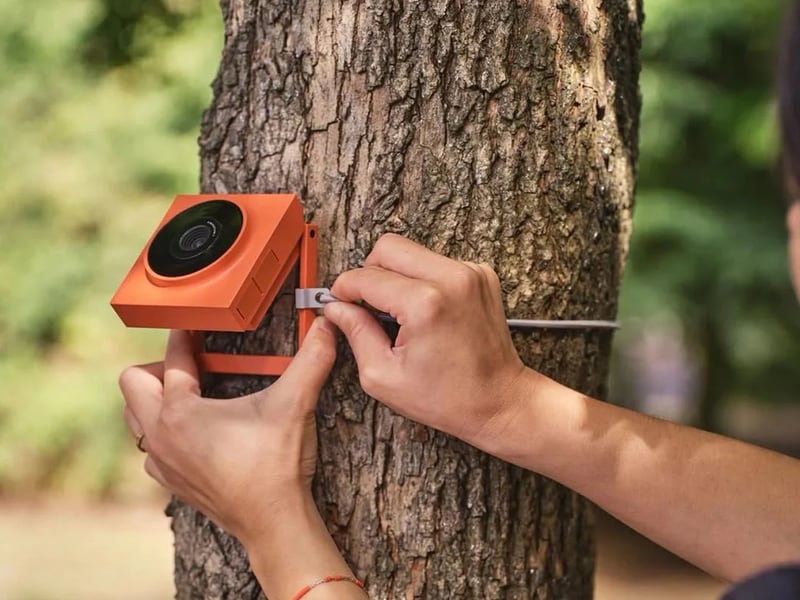
Minimal AI Wildlife Camera is a compact tracking device designed by Nicolas Fred and Thomas Fred, built to observe animals without disrupting their environment. The form removes screens, buttons, and visible interfaces, presenting a monolithic object that functions more like a sensor than a traditional camera. Its reduced footprint and neutral surface allow it to blend into natural surroundings, supporting deployment in remote locations where visibility can affect animal behavior.
The system integrates AI processing directly into the device, enabling real-time identification of species and filtering of irrelevant motion. This reduces the need to manually review large volumes of footage, shifting the camera from passive recording to active data interpretation. The structure suggests modular placement across different terrains, including trees and water edges, with a simplified geometry that improves durability and limits points of failure in outdoor conditions.
Image Credit: Nicolas Fred, Thomas Fred
Why This Trend Is Growing
- Embedded Edge AI Sensing
- On-device inference enables immediate species classification and reduces bandwidth and storage demands, enabling dense deployments in remote areas.
- Stealthy Environmental Design
- Minimized interfaces and neutral form factors lower animal disturbance and extend realistic behavioral datasets for ecological research.
- Modular Distributed Sensor Networks
- Interchangeable, rugged modules allow scalable arrays that provide high-resolution spatiotemporal tracking across diverse terrains.
Industries Being Reshaped
- Wildlife Conservation
- Passive, low-impact sensors offer long-duration monitoring that can reveal migration patterns and population trends with minimal human interference.
- Agricultural Monitoring
- Camouflaged AI sensors can detect pest outbreaks and livestock movement at field scale while minimizing visual disruption to crop systems.
- Security and Surveillance
- Discrete, AI-enabled nodes provide autonomous threat filtering and reduce false alarms by interpreting contextual behavioral data.