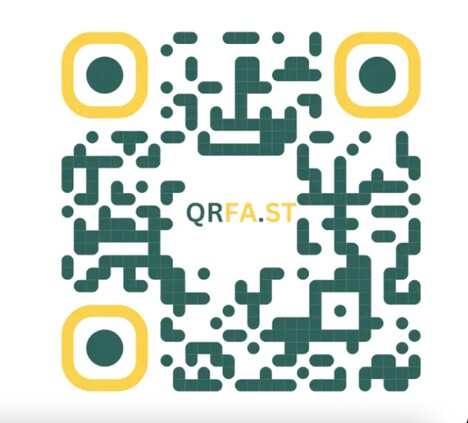
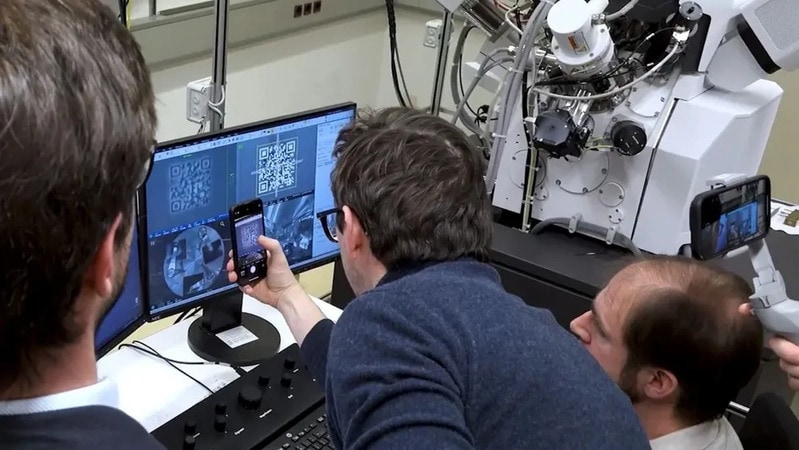
Researchers at TU Wien, working with Cerabyte, introduced a microscopic QR code that covered just 1.98 square micrometers, featuring pixels etched at 49 nanometers into a thin ceramic film.
The team announced the result as a Guinness World Record and validated the code by imaging it with an electron microscope, then displaying that image for a conventional phone scan. The ceramic medium is noteworthy for its stability and potential longevity, designed to preserve information without continuous power or active cooling.
The method mirrors archival approaches by encoding data into durable materials and could enable ultra-dense, long-term physical storage. For consumers and institutions, the work suggests future pathways for imperishable data tags and archival media, though practical scanning remains limited to electron microscopes today.
Image Credit: TU Wien
Key Themes Behind This Trend
- Nanoscale Data Encoding
- Encoding information at nanometer scales enables orders-of-magnitude increases in physical data density, opening possibilities for ultra-compact archival layers embedded in materials.
- Durable Ceramic Archival Media
- The use of chemically stable ceramic films for long-term data storage suggests new media that can preserve critical records without power or active environmental control.
- Microscopic Authentication Tags
- Embedding microscopic QR-like identifiers into products or documents offers a near-imperceptible method for provenance marking that is resistant to casual tampering.
Where This Applies
- Data Archiving and Preservation
- Institutions storing cultural, legal, or scientific records could leverage nano-etched, long-lived media to ensure information survives for centuries without digital migration cycles.
- Semiconductor Manufacturing
- Advanced lithography and etching capabilities are positioned to adapt techniques for patterned information encoding on non-electronic substrates, expanding the role of fabs beyond circuits.
- Security and Anti-counterfeiting
- High-resolution microscopic identifiers integrated into supply chains present a robust layer for product authentication that is difficult to replicate with conventional printing.