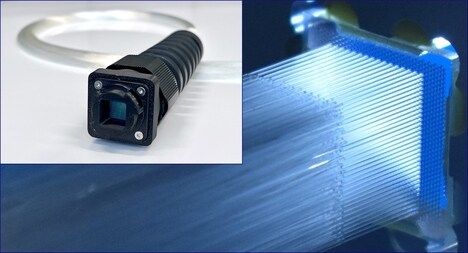

Founded by three former SpaceX engineers, Mesh Optical Technologies is taking on a market long dominated by Chinese manufacturers. The Los Angeles-based startup builds optical transceivers — devices that convert optical signals into electrical signals, enabling multiple GPUs to work together across data centers. CEO Travis Brashears, President Cameron Ramos, and VP of Product Serena Grown-Haeberli identified the opportunity while designing compute-heavy Starlink satellites, where the limitations of existing transceiver suppliers became impossible to ignore.
The $50 million Series A, led by Thrive Capital, will help Mesh scale to 1,000 units per day within the year. Beyond supply chain resilience, the company's current design eliminates a power-hungry component found in most transceivers, cutting GPU cluster energy consumption by an estimated 3% to 5%. With data center infrastructure at the center of the AI arms race, Mesh is positioning itself as a domestic alternative before trade restrictions make overseas sourcing a harder problem to solve.
Image Credit: Mesh Optical Technology
Key Themes Behind This Trend
- Domestic Semiconductor Supply Chains
- A shift toward local production of optical transceivers creates resilience against geopolitical risk and supply bottlenecks that could reshape procurement for AI-critical hardware.
- Energy-efficient Data-center Components
- Elimination of power-hungry elements in transceiver designs presents the potential to materially lower GPU-cluster operating costs and improve data-center energy density.
- Defense and AI Hardware Sovereignty
- Growing emphasis on domestic alternatives to foreign suppliers promises tighter control over sensitive compute infrastructure used in national security and advanced AI development.
Where This Applies
- Data Center Infrastructure
- Improved transceiver performance and efficiency could enable more cost-effective scaling of multi-GPU clusters and influence architecture choices for AI workloads.
- Optical Component Manufacturing
- A new US-based supplier scaling to high-volume production introduces competitive pressure and the opportunity for localized innovation in optical interconnects.
- Satellite and Space Systems
- Design lessons from space-grade transceivers offer rugged, low-power optical solutions that could be repurposed for terrestrial high-performance compute environments.