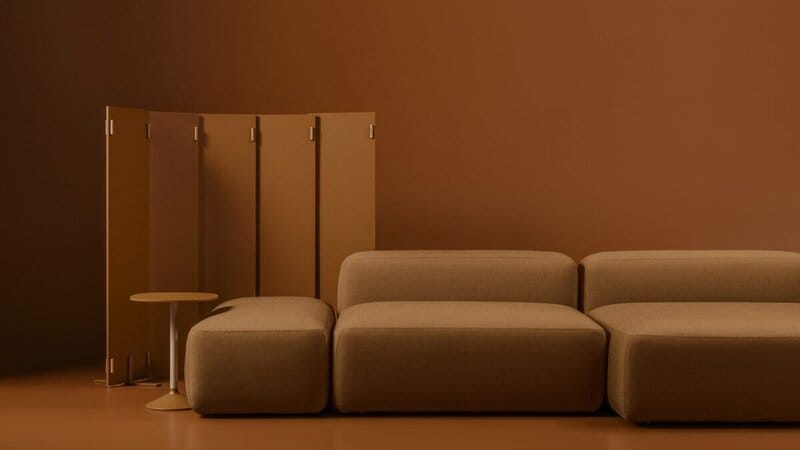
Italian brand Lapalma has collaborated with architect and designer Raffaella Mangiarotti on a new kaleidoscopic palette of colourways for its catalogue. Lapalma’s New Colour System, which debuted at Salone del Mobile, brings together 16 distinct shades designed to work across a range of its products. Seven existing colours have been rethought, while nine new shades expand the palette: Bianco, Tortora, Mattone, Celeste, Pistacchio, Perla, Nero, Sabbia, Limone, Corallo, Borgogna, Cannella, Oltremare, Alloro, Calce, and Gru.
Mangiarotti developed each shade through research into Lapalma’s historic use of colour, with the palette engineered to work across metal, wood, and plastic. The aim is to make colour a practical design tool, allowing seating and tables to share a coordinated aesthetic while retaining different forms, functions, and materials. Lapalma describes the palette as a “chromatic alphabet” that moves beyond simply updating its historic colours. Art direction is by Alberto Mora, with photography by Salva López.
Image Credit: Lapalma
Key Themes Behind This Trend
- Coordinated Colour Systems
- Unified palettes across product families create room for modular personalization, brand consistency, and faster specification in furniture and interior design.
- Material-adaptive Finishes
- Colour engineered for metal, wood, and plastic suggests new potential for surface technologies that preserve consistency across mixed-material collections.
- Chromatic Brand Identity
- Design-led colour libraries can transform palettes into recognizable brand assets that support seasonal updates without altering core product forms.
Where This Applies
- Furniture Design
- Coordinated colour frameworks give manufacturers a way to refresh catalogues, extend product lifecycles, and simplify customization for commercial and residential buyers.
- Interior Architecture
- Specifiers benefit from cross-category palettes that make cohesive spatial planning easier across seating, tables, finishes, and decorative elements.
- Surface Materials
- Advanced coating and pigmentation systems gain relevance as brands seek durable, consistent hues across varied substrates and manufacturing processes.