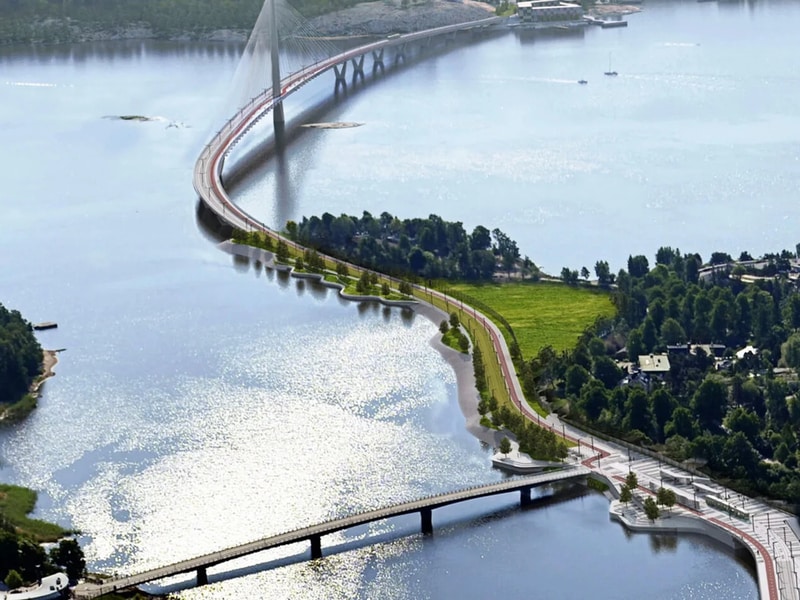
The Kruunuvuori Bridge in Helsinki is a 1,191-metre cable-stayed crossing designed exclusively for pedestrians, cyclists, and public transport. The Kruunuvuori Bridge Helsinki connects the island districts of Korkeasaari and Kruunuvuorenranta to the city, forming part of the larger Crown Bridges infrastructure project. The structure opened to the public in April 2026, with no private cars permitted on the route.
The bridge features a central pylon rising approximately 135 metres and a curved deck engineered to improve user experience while walking or cycling across the span. It will also support a tram line scheduled to begin operation in 2027, integrating public transit into the crossing. Designed as Finland’s longest and tallest bridge, the project establishes a new connection between eastern residential areas and central Helsinki while prioritizing non-car mobility.
Image Credit: WSP, Knight Architects
What's Driving This Trend
- Car-free Urban Infrastructure
- Repurposing major transport corridors for pedestrians and cyclists creates opportunities for mobility ecosystems that deprioritize private vehicles and reshape urban land use.
- Active Mobility Priority
- Elevated emphasis on walking and cycling infrastructure is enabling integrated services and amenities tailored to non-motorized users that change last-mile connectivity.
- Transit-integrated Bridge Design
- Designing bridges to carry light rail and trams alongside pedestrian flows introduces multifunctional structures that blur the line between public transit and public space.
Who This Affects Most
- Urban Planning
- Shifts toward car-free corridors are prompting new zoning paradigms and public realm strategies that alter real estate value patterns and neighborhood development models.
- Public Transit Systems
- Coupling dedicated tram lines with active travel routes is generating demand for interoperable scheduling, ticketing, and service models that unify mobility modes.
- Civil Engineering and Construction
- Demand for long-span, user-centered bridge structures is accelerating materials innovation and modular construction techniques to deliver aesthetic, low-impact crossings.